How can warehouse productivity be improved?
In particular, for large-scale, high-volume logistics operations, the warehouse is the heart of the business. Increasing its productivity is vital to boosting profitability while maintaining high quality and safety standards.
Complex logistics warehouses are generally managed by a Warehouse Management System (WMS), software designed to manage the operational cycle. With this software, companies can control all logistics processes, from receiving goods to shipping them out.
However, WMS has one limitation: it cannot manage events in real time. The list of tasks organized by the software does not account for changes in circumstances caused by other ongoing operations, delivery delays, machine breakdowns, or bottlenecks that slow down the handling of goods.
To increase productivity and warehouse profitability, a "booster" must be added to the WMS.
What is Ubiquicom Synchro and how does it work?
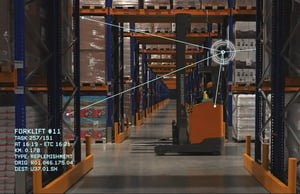
Synchro is Ubiquicom's AI-powered fleet management and WMS optimization system. It connects real-time forklift location data from the RTLS infrastructure with warehouse management system (WMS) mission data, and uses artificial intelligence to automatically assign the most appropriate forklift and operator to each task in real time. By continuously optimizing task dispatch based on vehicle proximity, availability, load status, and traffic conditions, Synchro eliminates inefficient manual dispatching and reduces unnecessary travel distances throughout the facility.
What makes Synchro unique in the RTLS fleet management market?
Synchro is the only AI-powered fleet management system in the RTLS market that natively integrates real-time vehicle positioning with WMS task optimization. While traditional fleet management tools track vehicle location, they do not automatically optimize mission assignments based on that data. Synchro closes this loop: it uses AI to dynamically match missions to the best available vehicle, accounting for real-time warehouse conditions. This makes Synchro a unique differentiator that elevates RTLS from a visibility tool to an active operational optimization engine.
How does Synchro integrate with existing WMS platforms?
Synchro integrates with existing WMS platforms through standard APIs and data connectors. The integration allows Synchro to receive mission queues and task priorities from the WMS, overlay them with real-time RTLS positioning data, and return optimized task assignments back to the WMS or directly to operator terminals. This bi-directional integration means Synchro enhances the WMS without replacing it, and can typically be deployed alongside major WMS providers with minimal custom development. Implementation timelines vary based on WMS complexity and data availability.
What operational efficiency gains does Synchro deliver?
Synchro delivers efficiency gains across multiple dimensions of warehouse operation. By optimizing task assignment, it reduces the total distance traveled by forklifts per shift, which increases throughput without adding vehicles or headcount. It also reduces idle time — forklifts spend more time on productive missions and less time waiting for manual dispatch or searching for the next task. Customers report measurable improvements in picks per hour, mission completion rates, and overall warehouse productivity after deploying Synchro. Fuel and battery consumption also decrease as a result of optimized routing
Who is Synchro designed for?
Synchro is designed for warehouse managers, logistics directors, and operations managers in medium to large industrial facilities that operate fleets of forklifts or other material handling vehicles. It is particularly valuable in high-throughput environments where task volume is high, missions are complex, and manual dispatching creates bottlenecks. Industries that benefit most include third-party logistics (3PL), distribution centers, manufacturing plants, and cold chain operations where efficiency directly impacts customer service levels and cost competitiveness.
Does Synchro require a full RTLS infrastructure to operate?
Yes, Synchro relies on real-time vehicle positioning data provided by the Ubiquicom RTLS infrastructure, typically based on UWB anchors installed throughout the facility and UTAG tags or NeoBox units mounted on each vehicle. The RTLS provides the accurate, low-latency location data that the AI engine needs to make optimal assignment decisions. However, Ubiquicom's modular approach means the RTLS infrastructure deployed for Synchro can simultaneously support other products such as Proximity, BlueBox, and TrackVision, maximizing the return on infrastructure investment.
Can Synchro be used to monitor fleet KPIs and generate reports?
Yes, Synchro includes a management dashboard that provides real-time and historical visibility into fleet KPIs including vehicle utilization rates, mission completion times, operator productivity, idle time, and distance traveled per shift. These metrics can be filtered by vehicle, operator, zone, or time period and exported for reporting purposes. The data supports management decisions about fleet sizing, shift planning, layout optimization, and operator training, transforming raw RTLS data into actionable business intelligence.
How does Synchro contribute to measurable ROI in warehouse operations?
Synchro delivers ROI through direct operational savings. Reduced forklift travel distances lower energy consumption and extend battery or engine life. Higher throughput per vehicle delays the need for fleet expansion. Elimination of manual dispatching reduces labor overhead in coordination roles. Faster mission completion improves service levels to downstream customers or production lines. Customers who deploy Synchro typically achieve measurable productivity improvements within the first operating quarter, with full ROI realized within 12 to 24 months depending on fleet size and operational volume.