Skip to content
SHINDAN

Remote diagnostics for forklifts and industrial vehicles


Monitor, prevent, respond: the solution that helps dealers and rental companies keep their fleets up and running

Reduced costs and downtime, minimal machine downtime

Why use SHINDAN?

SHINDAN is the TrackVision add-on that allows the remote diagnostic service for detecting anomalies in material handling vehicles. The system allows reducing the technicians' on-site traveling with a positive impact on productivity and on the reduction of vehicle maintenance costs.

Based on UBIQUICOM's BlueBox, the remote diagnostic system enables you to identify faults in forklifts remotely, without the need for on-site visits or additional software installation.

The system enables you to:

  • reduce fault resolution times
  • reduce downtime for maintenance
  • optimally manage the spare parts inventory
  • save on maintenance costs
  • limit the number of technician visits for environmental and energy sustainability reasons.

The benefits of remote diagnostics for your fleet

icon_ambiente
Environmental sustainability
  • Reducing technician travel helps lower emissions.
  • Timely maintenance improves forklift performance and extends their service life.
  • Efficient management ensures optimal use of spare parts.
icon-trend
Improved forklift performance
  • optimizes maintenance
  • ensures safer machines
  • ensures optimal performance
icon-assets-connections
Improved productivity
  • Faster diagnostics to reduce downtime and maintain operational continuity.
  • Prompt assistance that streamlines workflows.
  • Increased productivity thanks to more efficient, uninterrupted processes.
icon-carrello-elevatore-lampeggiante
Remote forklift connection

SHINDAN allows for a wireless connection between the forklift and the maintenance technician. This enables the technician to diagnose faults remotely.

icon-chrono
More immediate interventions

The technical staff can perform more interventions thanks to remote diagnostics management, which has improved their efficiency.
How does remote diagnostics work?

Manufacturers of industrial machinery offer diagnostic and configuration tools for their machines.

The main features implemented are:

  • diagnosis of anomalies on the machine
  • configuring specific features, such as speed limitations, machine behavior, advanced functionality.

Usually, these tools are owned by manufacturers and use the CAN Bus as a communication interface with the machine.

A laptop and diagnostic software, along with a USB adapter - CAN Bus, are available to the maintenance technician to connect to the control unit of the machine, which is then linked to the BlueBox.

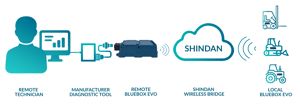
Through the use of 2 BlueBoxes - one connected to the machine and one connected to the adapter supplied to the technician - thanks to SHINDAN, a wireless bridge is created removing the need to be physically close to the machine and thus giving the technician the possibility to intervene remotely.

Usually, these tools are owned by manufacturers and use the CAN Bus as a communication interface with the machine.

UBIQUICOM won the Vodafone Call - Action for 5G 2022 with SHINDAN, the remote diagnostic solution for the detection of anomalies in industrial equipment.

Remote diagnostics on industrial vehicles: operating diagram, infographic

The principal advantages of remote diagnostics

  • Greater operational continuity, thanks to reduced machine downtime.
  • Lower overall costs, with faster, more targeted interventions and fewer on-site service calls.
  • Optimized resource management, from spare parts management to maintenance planning.
  • Extended service life of forklifts, by preventing premature wear and tear.
  • Tangible sustainability, with lower emissions from travel and reduced energy waste.

Remote diagnostics isn’t just about more efficient maintenance: it’s a strategic tool for improving operational performance and business competitiveness.

Contact us

Ask our sales for information, demos and a quote

Get in touch with us, share your needs, context and project ideas, and get a quick consultation.
FAQ

FAQ about remote diagnostics

What is the best way to reduce costs and downtime while maintaining the efficiency of lifting equipment?

A well-maintained forklift is essential for ensuring worker safety and productivity.

When a forklift breaks down or there is a suspicion of an impending breakdown, wear, or system failure, it is necessary to contact the maintenance technician, who will schedule an appointment, conduct an on-site inspection, determine the nature of the problem, and, if necessary, order replacement parts before returning to the site at a later time to perform the replacement in the event of a breakdown.

In the meantime, the machine operates at reduced capacity or, in the case of more serious breakdowns, is shut down, causing costly delays in the production cycle.

How does remote diagnostics for forklifts work?

Shindan is Ubiquicom’s remote diagnostic system for forklifts and industrial vehicles, inspired by the OBD (On-Board Diagnostics) concept used in road vehicles.

The system connects to the forklift’s onboard electronics and reads error codes, operating parameters, and diagnostic data in real-time.

This information is transmitted to the Ubiquicom cloud platform and made available to fleet managers and maintenance technicians via a dedicated dashboard. Shindan enables the identification of impending failures before they cause downtime, reducing the costs of unplanned maintenance.

What diagnostic data can be retrieved from a forklift?

Shindan reads a wide range of diagnostic parameters from the forklift's electronics: error codes and anomalies detected by the vehicle control system, electrical system parameters (battery voltage, state of charge, current draw), temperature of critical components (motor, controller, battery), engine hours and usage meters, hydraulic parameters (pressure, fluid temperature), wear data for key components, and error history with timestamps.

This data, combined, provides a comprehensive picture of the vehicle's health and enables predictions of maintenance needs.

Is Shindan compatible with all brands of forklifts?

Shindan is designed to support the leading forklift manufacturers on the Italian and European markets. Compatibility with each model depends on the electronic communication protocol used by the manufacturer and the level of openness of the vehicle’s diagnostic interface. Ubiquicom has developed specific connectors for the platforms of the leading brands (Toyota, Jungheinrich, Crown, Still, Linde, and others).

As a member of the ZAPI GROUP, which develops control systems for industrial electric vehicles, Ubiquicom possesses in-depth knowledge of the communication protocols used by major vehicle platforms. We recommend verifying the specific compatibility of your fleet by contacting our technical team.

How does Shindan help reduce fleet maintenance costs?

Shindan significantly reduces maintenance costs through several mechanisms: predictive maintenance based on actual usage data and component status — rather than fixed schedules — avoids premature preventive maintenance and identifies necessary interventions in advance; early detection of anomalies allows for action before a minor issue turns into a costly failure or sudden machine downtime; optimized maintenance management based on actual hours of use (rather than elapsed time) extends the life of components.

Companies that adopt Shindan report significant reductions in unplanned maintenance costs and unexpected production downtime.

Does Shindan send automatic alerts when it detects a problem with the shopping cart?

Yes, Shindan includes a configurable automatic alerting system designed to immediately notify the appropriate personnel when anomalies or errors are detected on the vehicle. Alerts can be sent via email, SMS, or push notification to the mobile app for maintenance supervisors, fleet managers, or the forklift manufacturer’s technical staff.

The severity of the alert is graded based on the criticality of the anomaly: ranging from informational notifications for parameters approaching warning thresholds to urgent alerts for failures that require the vehicle to be stopped immediately for safety reasons or to prevent serious damage.

Does Shindan integrate with corporate computerized maintenance management systems (CMMS)?

Yes, Shindan can integrate with major enterprise maintenance management systems (CMMS) via API. This integration allows maintenance work orders to be automatically created in the CMMS when Shindan detects an anomaly or when a vehicle reaches the scheduled threshold for routine maintenance.

Shindan’s diagnostic data can also enrich work orders with detailed technical information that helps technicians prepare for the service call with the correct parts, reducing downtime. Integration is also available with corporate ERP systems and fleet management systems.

Is it possible to access Shindan data remotely outside of business hours?

Yes, the data collected by Shindan is accessible via Ubiquicom’s cloud-based web platform 24/7 from any browser on a PC, tablet, or smartphone. Maintenance managers can check the status of the fleet remotely at any time without being physically present at the warehouse.

The mobile app allows users to receive real-time push notifications and view details of detected anomalies. This feature is particularly useful for companies with 24/7 operations, night shifts, and technical managers overseeing multiple sites.