
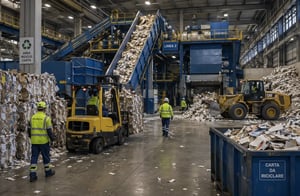
As the circular economy continues to grow, recycling facilities are handling larger volumes of materials than ever before. At the same time, ensuring high safety standards has become increasingly important in environments where operators, forklifts, wheel loaders, excavators and other material-handling vehicles work side by side.
Understanding the main causes of workplace accidents and the dynamics that create hazardous situations is the first step toward reducing injuries, protecting workers and improving operational continuity in recycling facilities.
Why Paper Recycling Is a High-Risk Environment
Paper recycling plants are characterized by constant interaction between people, industrial vehicles, material-handling equipment and processing lines.
Pedestrian workers, forklifts, wheel loaders and excavators frequently share the same workspace. These conditions are often compounded by congested traffic routes, large paper bales, dust, noise and reduced visibility.
According to Eurostat, 27.1% of fatal workplace accidents in the European Union are caused by the loss of control of machinery, tools or transport and handling equipment.
For this reason, human-machine safety is one of the most critical challenges facing the recycling and material recovery industry today. Ensuring safe interactions between workers and mobile equipment is essential to reducing occupational risks and improving workplace safety performance.
Le statistiche confermano che il settore della gestione e del recupero dei rifiuti presenta livelli di rischio superiori alla media.
Human-Machine Interactions: One of the Main Operational Safety Challenges
One of the most complex safety issues in recycling plants is managing interactions between workers and industrial vehicles.
An analysis conducted through INAIL's Infor.MO. accident monitoring system identified recurring issues related to the simultaneous presence of workers and vehicles within the same operational areas.
Specifically:
- 38.4% of causal factors were linked to unsafe worker behaviors, including incorrect positioning near vehicles and crossing vehicle operating areas.
- 29.1% were related to the actions of other workers and shortcomings in managing operational interactions.
- 22.1% were associated with deficiencies in workplace organization, traffic routes and maneuvering areas.
- 10.5% involved missing or inadequate vehicle safety and warning systems.
According to INAIL, fatal struck-by incidents often involve multiple risk factors occurring simultaneously, confirming that accidents are frequently the result of interactions between people, vehicles and workplace organization
Real-World Accidents: When People and Vehicles Share the Same Space
The UK Case
In January 2020, aworker at a waste recycling facility in Hartlepool, United Kingdom, was struck and killed by a wheel loader while crossing the site.
The subsequent investigation by the Health and Safety Executive (HSE) concluded that the company lacked adequate traffic management measures and had failed to establish effective separation between pedestrian routes and operational vehicles. The company was later convicted of corporate manslaughter and fined more than £2 million.
The Italian Case
In July 2024, a worker lost his life at a waste management facility in the province of Cagliari, Italy, after being struck by an excavator.
According to media reports, the equipment operator was unaware of the worker's presence within the operating area. The incident highlights the risks associated with the simultaneous presence of ground personnel and heavy material handling machinery.
How Much Does a Workplace Injury Cost?
Workplace safety is not only an ethical and regulatory issue. Occupational accidents can also have a significant financial impact on businesses.
According to data presented by Conflavoro PMI, a workplace injury resulting in an average absence period of approximately fifteen days can generate direct costs of around €7,500 for the employer.
Some estimates suggest that the total cost of a single workplace accident can reach €55,000 to €64,000 when indirect costs are included.
Hidden Costs of Workplace Accidents
- production downtime;
- replacement of injured personnel;
- training and onboarding of temporary staff;
- equipment damage;
- delivery delays;
- increased insurance costs;
- internal investigations;
- reputational damage
Conclusions
The data clearly show that risks in paper recycling facilities are closely linked to interactions between workers and industrial vehicles. The coexistence of pedestrians, forklifts, wheel loaders and excavators makes it essential to implement preventive measures capable of reducing vehicle-related incidents and improving operational safety.
Understanding why accidents occur is the first step. The next step is identifying the most effective technologies to prevent human-machine collisions and vehicle-to-vehicle collisions, particularly in environments characterized by restricted visibility, crowded workspaces and intensive material handling operations.
In our next article, we will explore the issue of blind spots and industrial collision avoidance technologies, with a focus on Proximity Third Eye, Ubiquicom's solution designed to improve driver situational awareness and help reduce vehicle-related risks in industrial environments.