
Collision avoidance to enhance paper recycling facilities safety
Optimization of operational safety, with a reduction in the risk of collisions between material-handling vehicles and operators in paper-processing plants

Italian leader in paper collection and recycling
A major Italian industrial company specializing in the management, collection, sorting, and processing of paper through various recycling facilities located in Lombardy, primarily in the province of Milan. Separately collected paper and cardboard are sorted and packaged before being sent to paper mills to be transformed into new packaging. The company’s operations are spread across six sites.
Prevention of accidents involving vehicles and people, real-time monitoring, and risk reporting to improve safety at the plant.
The customer's aim was to enhance safety levels within the production site, minimizing the risk of collisions between operational vehicles and personnel, both indoors and outdoors.
In an environment characterized by high operational complexity and the presence of forklifts, wheel loaders, and trucks with variable traffic flows and dwell times, the need arose to implement advanced preventive measures capable of mitigating the risks associated with interactions between people and vehicles.
At the same time, it was essential to ensure real-time monitoring of operators and assets to guarantee that specific areas remained clear during critical operations or emergency situations.
The solution had to include the ability to extend functionality to the management of sensitive areas through personnel tracking, using a single integrated device for collision prevention, with the ultimate goal of creating a safer, more controlled, and more efficient work environment.
High-precision collision avoidance and location in critical areas.
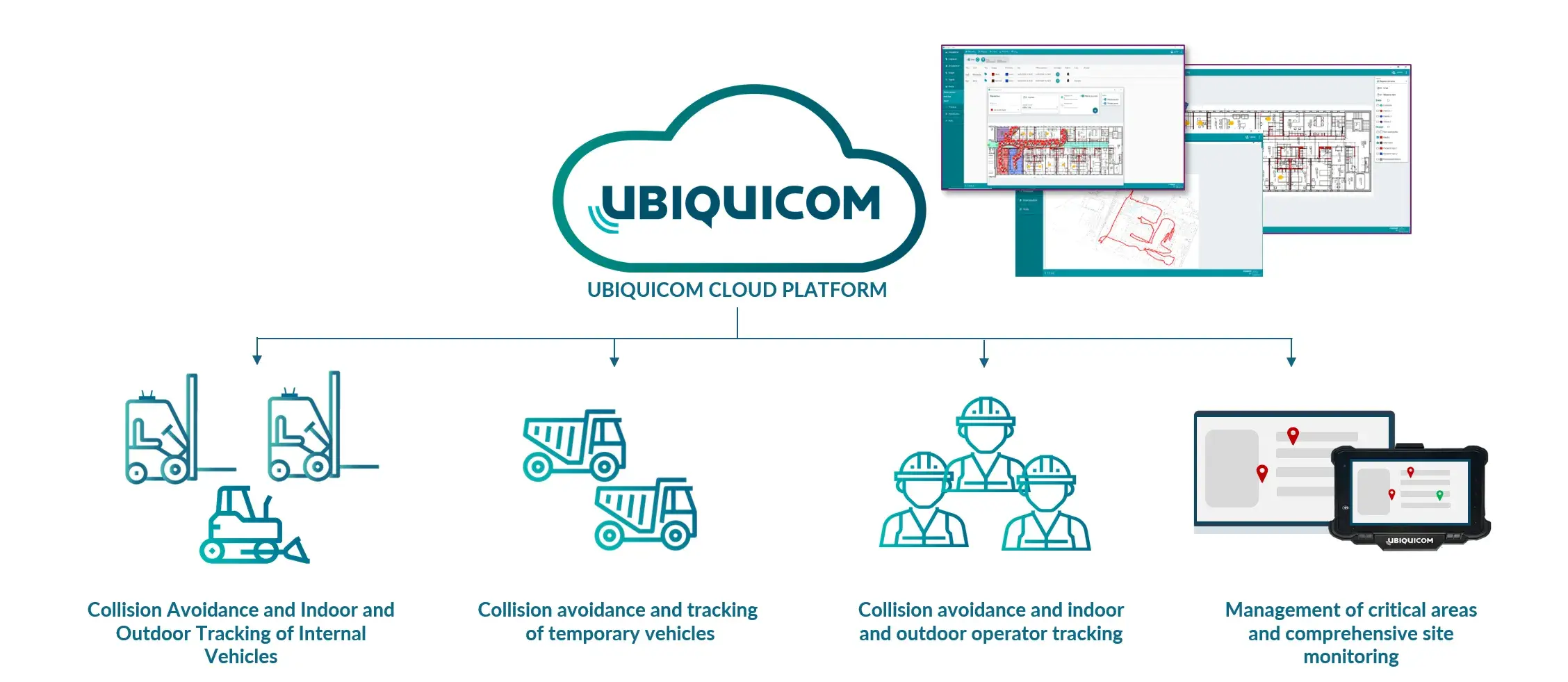
The solution proposed by UBIQUICOM involved the implementation of an integrated security and tracking system based on advanced technologies, which has significantly improved operational control and risk prevention within work areas.
Specifically, all operational vehicles in the area were equipped with the UBIQUICOM PROXIMITY THIRDEYE system, based on Ultra Wide Band (UWB) technology, which allowed for the custom configuration of safety zones according to the characteristics of each vehicle, thereby ensuring optimized performance and a high level of safety.
At the same time, operators have worn PROXIMITY tags equipped with UWB technology from the moment they entered the site, which have helped prevent potential collisions by allowing the systems installed on the vehicles to promptly detect the presence of people even under conditions of limited visibility, such as near blind spots or obstacles. Additional tags were also attached to vehicles granted temporary access to the work area, reducing the risk of interference with operational vehicles and improving alerts to operators when vehicles are approaching.
With regard to location tracking, in indoor (INDOOR) areas, operational vehicles equipped with the UBIQUICOM solution were monitored in real time via a network of fixed UWB antennas, which ensured high tracking accuracy.
In outdoor areas characterized by greater complexity (OUTDOOR)—particularly those prone to interference between people and vehicles or used for loading and unloading hazardous materials—accurate tracking of both personnel and outdoor vehicles was enabled via UWB technology, allowing for the automated management of events, alarms, and any evacuation procedures.
The antenna layout was designed and optimized based on the risk level of the various areas and the required degree of accuracy, ensuring effective coverage consistent with operational needs.
Finally, in outdoor areas, internal vehicles equipped with the UBIQUICOM solution were also tracked in real time using GNSS technologies, thus ensuring continuity in the monitoring and control of activities even outside indoor environments.
Frequently asked questions about anti-collision systems, workplace safety and real-time location in industrial facilities
An anti-collision system can detect the real-time presence of people and vehicles, helping reduce the risk of accidents in operational areas. UBIQUICOM uses Ultra Wide Band (UWB) technology to develop anti-collision solutions that can be configured according to vehicle types, operating environments and required safety distances. In a leading Italian paper recycling facility, the solution was deployed on forklifts and other industrial vehicles and integrated with UWB tags worn by workers.
Real-time detection and positioning technologies can help identify potentially dangerous interactions between pedestrians and industrial vehicles. UBIQUICOM uses UWB tags worn by workers and vehicle-mounted systems to detect personnel even in areas with obstacles or limited visibility. In the paper recycling project, this approach was used to manage interactions involving workers, forklifts, wheel loaders and trucks.
UBIQUICOM PROXIMITY THIRDEYE anti-collision systems use UWB technology to detect people and vehicles even when they are not directly visible to the operator. Safety zones and warning distances can be configured according to vehicle type, environmental conditions and risk levels. In the recycling plant project, workers were equipped with UWB tags to ensure reliable detection near obstacles and blind corners.
Ultra WideBand (UWB) technology provides highly accurate distance measurement between people and industrial vehicles, even in complex environments with obstacles and interference. This is why UBIQUICOM uses UWB in both its anti-collision and Real-Time Location System (RTLS) solutions to improve workplace safety. In the paper recycling project, UWB technology was used for both collision avoidance and high-accuracy positioning in critical areas.
A Real-Time Location System (RTLS) enables the continuous tracking of workers, forklifts, industrial vehicles and other assets. UBIQUICOM develops RTLS solutions using different positioning technologies according to environmental conditions and accuracy requirements. In this project, indoor tracking was achieved through a UWB infrastructure, while outdoor areas leveraged both UWB and GNSS technologies.
Yes. Different positioning technologies can be integrated into a single architecture to provide continuous visibility across indoor and outdoor environments. In the paper recycling facility, UBIQUICOM combined UWB and GNSS technologies to ensure seamless monitoring and support safety requirements across multiple operational areas.
Safety zones can be configured according to plant layout, vehicle types, operational processes and risk assessments. UBIQUICOM designs the positioning infrastructure and detection parameters based on the accuracy and safety requirements of each area. In this project, the solution was specifically optimized according to the operational characteristics and risk profile of each section of the facility.
Temporary vehicles can be equipped with tags that allow them to be detected by the anti-collision system. In the paper recycling project, UBIQUICOM deployed PROXIMITY tags on external vehicles to help reduce the risk of interactions with operational vehicles and on-site personnel.
Real-time location data makes it possible to associate the position of people and vehicles with specific operational areas and safety conditions. UBIQUICOM solutions can use this information to support event management, safety alerts and emergency procedures. In the project, UWB-based location tracking was used in critical areas to automatically manage alarms, events and operational safety conditions.
Yes. Anti-collision systems can be configured according to site characteristics, vehicle types, traffic flows and risk levels across different operational areas. UBIQUICOM combines anti-collision technology, UWB positioning and GNSS tracking within configurable architectures. The paper recycling project demonstrates how these technologies can be integrated to address multiple safety requirements within the same facility.
Yes. UBIQUICOM solutions can be deployed in a wide range of industrial environments where people, vehicles and assets need to be monitored and protected. The architecture implemented in the paper recycling project can be adapted to manufacturing facilities, warehouses, logistics centers, ports, intermodal terminals, processing plants and other industrial sites based on operational requirements and positioning accuracy needs.