
IoT-RTLS for fruit and vegetable packaging lines
IoT RTLS solution for monitoring production costs and increasing productivity in an apple packaging plant
A model of efficiency and innovation in the fruit sector
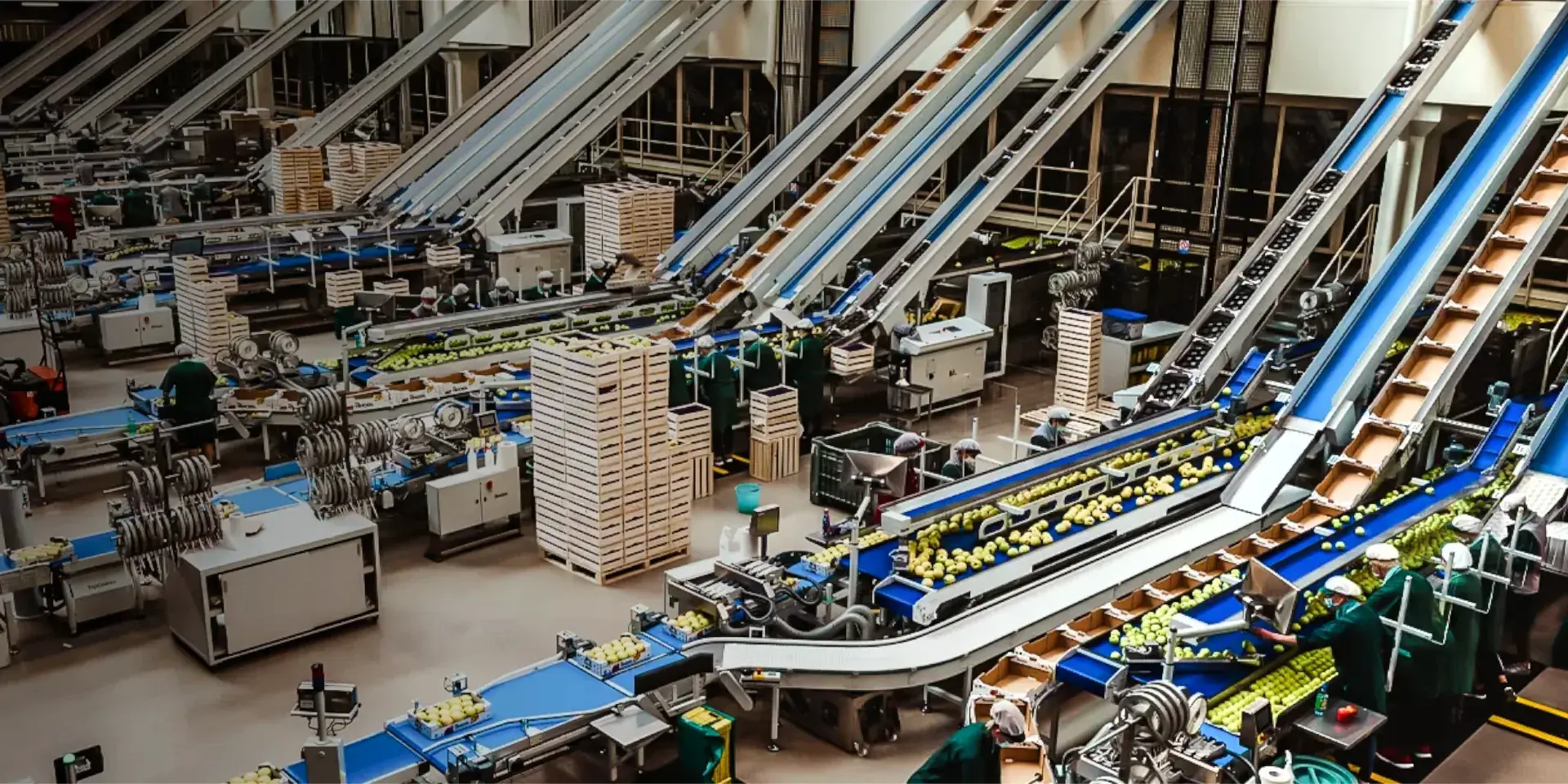
MIVOR coop. fruit growers MIVO-ORTLER Soc., based in Laces, Bolzano, is one of Italy's major cooperatives for the preservation, selection, and packaging of apples grown in Val Venosta, South Tyrol. It has 340 members and a planted area of 1,070 hectares, producing around 75-80 thousand tonnes of apples, all of which are preserved and processed in the cooperative's 9-hectare factory.
The huge processing area has been completely refurbished in recent years, using cutting-edge technology. The new MIVOR processing room is a result of an accurate project that allows for increased process efficiency through innovative approaches while also increasing the plant's sustainability. It has 16 revamped and ergonomic packing lines, of which three are dedicated to packaging.
Time tracking at workstations: accuracy, automation and regulatory compliance
MIVOR needed an automated solution that allocates operators expenses among production lines and other production areas while observing privacy and worker control regulations.
The required output was a report containing the total minutes and seconds spent by staff at each workstation along each production line.
Ultra Wideband technology and advanced software for intelligent production line management
Ubiquicom developed and implemented a solution utilising Ultra Wideband (UWB) technology. This solution provides real-time tracking of every individual in the workplace, with two updates per second and an error margin of less than one metre.
Using the Ubiquicom Locator platform, worker positions were drawn along the lines defining each workstation's reference area. The project-affected areas had been equipped with 27 UWB anchors that were connected and powered by Ethernet cable. The keyring that each worker already had had been equipped with a UWB tag and a passive RFID tag. This allows every worker to always carry their precise location tag, which is also required for clocking in.
The software's reports are anonymous and only show the total time committed to each line without tracking the locations of any particular employees, in full compliance with worker privacy protection requirements. Ubiquicom and MIVOR management were involved in each stage of the project, from requirements gathering to device assembly and production.
Verified results and advanced automation for more efficient production lines
The accuracy of the system and the solution's compliance with the client's requirements have been confirmed through a comparison of particular work area images with corresponding screenshots of the positions recognized by the system in certain randomly selected moments over a few working days.
As a result, it was easy to identify critical workstations and fine-tune the setup until the Locator platform's data matched exactly what happened on the production lines.
The currently detected positions represent the operation and may be used not only to generate the necessary reports, but also to automatically adjust the speed of the lines according to the number of workers, through integrating the system with the line's PLCs.
Questions and insights
MIVOR is an Italian industrial company specialized in the processing and packaging of fruit and vegetable products.
It operates in a sector characterized by high demands for production efficiency, goods traceability, compliance with food regulations, and waste reduction.
Fruit and vegetable production has a specific management complexity: perishable products with narrow time windows, packaging lines with high variability of formats and product types, and the need for accurate reporting of production costs for each batch.
Industrial accounting control is therefore a fundamental driver for competitiveness.
MIVOR's main challenge was optimizing industrial accounting and controlling production costs per packaging line.
Without precise visibility on where workers and equipment were located during operations, it was difficult to correctly allocate operational costs to individual production batches, identify the least efficient lines, or detect non-productive downtime. This made production planning imprecise and economic reporting approximate, limiting MIVOR's ability to identify areas of inefficiency and intervene with corrective actions based on objective data.
The IoT-RTLS system implemented for MIVOR monitors activity on the fruit and vegetable packaging lines in real time by tracking the operators and mobile equipment present in each production area.
The RTLS tags worn by operators or applied to equipment transmit their position to the sensor infrastructure, allowing the Ubiquicom platform to automatically calculate the attendance time of each resource for each processing line.
This data is integrated with production information (processed batches, packaged quantities, cycle times) to automatically generate industrial accounting per batch, correctly allocating labor and resource utilization costs to each production.
The adoption of the Ubiquicom IoT-RTLS system transformed MIVOR's industrial accounting from a manual and approximate process into an automatic and precise one.
The main benefits include: automatic allocation of labor costs to individual production batches based on the actual detection of attendance per line, identification of the most and least efficient packaging lines through comparable KPIs, reduction of time spent on manual data collection by department managers, and availability of historical data for trend analysis and continuous improvement.
The greater accuracy of accounting has allowed MIVOR to do more precise pricing and negotiate better with large retail customers.
Yes, the Ubiquicom solution implemented for MIVOR is designed in compliance with the health and hygiene regulations applicable to the food industry.
The RTLS tags used are made of materials suitable for contact with food environments, easy to sanitize, and resistant to cleaning cycles with industrial detergents.
The hardware is designed in accordance with HACCP regulations and food safety certifications, ensuring that the IoT infrastructure does not represent a contamination risk or an obstacle to plant hygiene procedures.
Ubiquicom has developed specific expertise for implementation in food & beverage environments, where hygiene needs are added to those of industrial robustness.
The approach of using RTLS for automatic industrial accounting — detecting the presence of operators and resources per production line and automatically allocating costs to batches — is applicable in any multi-line manufacturing context.
Sectors such as industrial component production, electronic assembly, pharmaceutical production, food processing in general, and textile manufacturing present challenges similar to those of MIVOR: the need for precise reporting per batch, management of human resources on multiple simultaneous lines, and optimization of production costs.
The Ubiquicom system eliminates manual data collection and guarantees objective cost data updated in real time.