Skip to content
Safety and collision avoidance systems for active safety

Active safety and anti-collision systems to protect workers, vehicles and assets

The challenges of safety in warehouses and production areas. A wide range of solutions based on the most advanced, high-precision real-time location technologies, to maximize worker safety.

Safety and collision avoidance systems for active safety


Watch how our solutions can protect workers and vehicles in your company


The value of safety

A safe environment costs the company up to 200% less

For every dollar invested in security, businesses get a return of $4.41

SOURCE: Liberty Mutual Research Institute for Safety, Harvard University and the University of Wisconsin-Oshkosh
Risks, injuries, costs

Don't take the risk and keep your business safe!

100,000 forklift accidents per year with an average cost of $180,000 per collision.

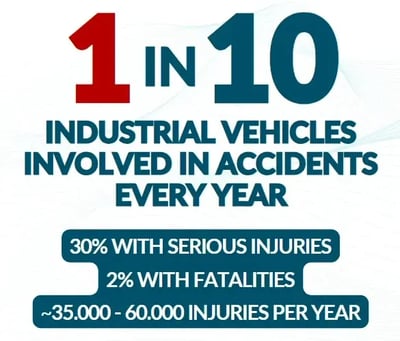
Safety statistics: 1 in 10 industrial vehicles involved in accidents every year

SOURCE: OSHA

Safety Ecosystem

Our safety solutions

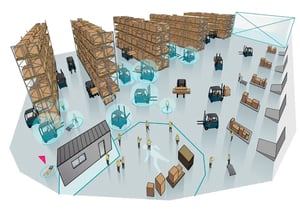
The UBIQUICOM Safety Ecosystem consists of a wide range of integrated solutions, based on the most advanced high-precision real-time localization technologies, to increase worker safety to the highest levels.

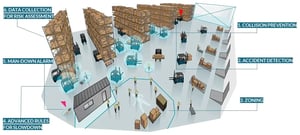
Safety functionality diagram of safety and collision avoidance systems

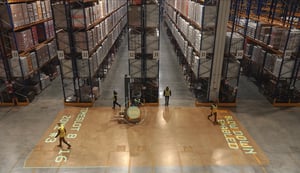
In manufacturing plants, warehouses, and many other areas of work, workers are exposed to risks every day when using or moving in contexts with vehicles and industrial machinery for handling and lifting.

The devices that are mounted on the machines and worn by pedestrians guarantee a high level of prevention for Pedestrian-Machine, Machine-Machine, and Machine-Fixed Obstacle accidents. thanks to the integration between different types of warning and danger signals, and systems of an automatic slowdown of the vehicles.

The solutions for active safety at work, allow:

  • preventing injuries and incidents
  • monitoring environments and identifying the most dangerous spots
  • interacting with operators in real-time
  • checking the health status of workers in indoor and outdoor contexts
  • reporting dangerous situations
Collision avoidance systems for industrial vehicles
Collision avoidance systems for forklifts and industrial vehicles
Industrial collision avoidance systems monitor the distance between static and moving obstacles to reduce the risk of vehicle-to-vehicle and vehicle-to-pedestrian accidents. Technologies used include UWB (Ultra-Wideband) and AOA (Angle of Arrival).
Zoning and slowing down industrial vehicles
Zoning and safety through real-time locating
Automatic speed reduction and forced slowdown in high-risk zones. Restricted entry to hazardous areas for unauthorized personnel or vehicles with access controls through gateways.
Access control and pre-operational checklist for industrial vehicles
Access control and pre-operational checklists for vehicles
Vehicle access only for certified operators with certification verification. Mandatory checks before equipment use with pre-operational checklists.
Ubiquicom's range of proprietary solutions

A complete modular system for safety

PROXIMITY
Safety & anti-collision
Collision avoidance and safety management systems, designed to prevent hazardous situations in which material handling vehicles operate.
TRACKVISION
Telemetry & fleet management
A platform that enables both safety and telemetry functions. It acquires vehicle data and provides information on near-miss accidents, vehicle access control, and pre-operation checklists.
LOCATOR
Real-Time Locating Systems
Platform for real-time localization, tracking of people, vehicles and assets, telemetry and real-time management of complex location-based events.

Benefits of advanced security systems

What benefits do active safety technologies offer?
icon-euro Lower insurance premiums

Reduced insurance costs thanks to improved accident history.

 
icon-report Incident reporting

Real-time analysis and historical data for data-driven preventive actions.

 
icon-safety Injury reduction

Up to 48% fewer collisions (industry data).

 
icon-badge Regulatory compliance

Meeting legal safety obligations and avoiding penalties.

 
Case studies

Success stories in active safety

What results have companies achieved thanks to Ubiquicom's safety and anti-collision solutions?

Contact us

How to improve the safety of your warehouse and production?

Book a demo of collision avoidance technologies to see the systems in action.
Blog articles

Learn more about safety from our blog

Read our articles on active safety and collision avoidance and find out how we can help your business reduce risks.

FAQ

Insights and FAQs on active safety

What are the main risks in industrial material handling?

Risks in machine handling:

  • Alarming statistics: 61% of warehouse injuries involve material handling equipment; almost 40% of injuries in the manufacturing sector are caused by material handling accidents.
  • Economic costs: downtime, compensation, increased insurance premiums, and non-compliance penalties.
  • Regulatory obligations: safety regulations impose specific prevention measures for workplace safety — including OSHA 29 CFR 1910.178 (US), EU Directive 89/391/EEC and Directive 2009/104/EC (Europe), and EU Regulation 2023/1230 on Machinery (applicable from January 2027).
  • Organizational impact: material damage and productivity loss.
Why do accidents occur in warehouses or manufacturing facilities?

Main causes of industrial vehicle accidents:

  • Poor visibility: blind spots of material handling equipment and high-interference zones.
  • Pedestrian-vehicle interaction: lack of distinction between operational areas and pedestrian pathways.
  • Excessive speed: driving behaviors not compliant with safety limits.
  • Absence of zoning: failure to define risk areas and controlled zones.

Read our blog article on industrial vehicle-related accident causes.

What are the main costs of an accident involving industrial vehicles?

Types of accident costs for a company:

  • Direct costs: sickness, compensation/insurance, medical expenses, legal/bureaucratic costs.
  • Indirect costs: lost productivity, recruitment and training of new resources, overtime, collateral damage to machinery and property.
  • Intangible costs: damage to reputation, negative effects on colleagues.
What are Ubiquicom's Active Safety Solutions for industrial environments? Ubiquicom's Active Safety Solutions are a portfolio of IoT and RTLS-based systems designed to prevent accidents in warehouses, factories, and industrial facilities where forklifts, industrial vehicles, and workers share the same operational space. Unlike passive safety measures such as barriers, floor markings, and signage, active safety solutions detect and respond to dangerous conditions in real time.
How do Ubiquicom safety solutions comply with workplace safety regulations? Ubiquicom's active safety solutions support compliance with EU workplace safety directives and national regulations including Italy's Legislative Decree 81/2008, the EU Machinery Directive, and ISO 3691-4 (safety requirements for industrial trucks operating in shared workspaces with pedestrians). The systems provide the technological infrastructure to meet risk assessment obligations under these regulations, document near-miss and incident data for regulatory reporting, and demonstrate active risk mitigation measures to labor inspectors and insurers. Automated logging of safety events — with timestamps, location, and asset identity — creates an auditable evidence trail that passive safety systems cannot provide. Ubiquicom supports customers in mapping product capabilities to specific regulatory requirements.
What is the difference between active and passive safety systems? Passive safety systems — physical barriers, painted floor zones, speed bump ramps, and safety signs — establish static boundaries that do not respond to real-time conditions. They rely entirely on worker compliance and cannot adapt when a forklift exceeds speed limits or a pedestrian enters a danger zone undetected. Active safety systems, by contrast, continuously monitor the position and behavior of every tagged vehicle and person in real time and intervene automatically when unsafe conditions arise. Ubiquicom's active safety portfolio detects proximity violations, triggers immediate bilateral alerts on both the vehicle operator and the pedestrian, enforces speed restrictions electronically, and logs every event for safety analytics. This dynamic response addresses the root causes of industrial accidents rather than simply marking risk areas.