
Asset Tracking Indoor and Outdoor
Optimization of warehouse search time and journey time for products transportation. Streamline asset management across environments
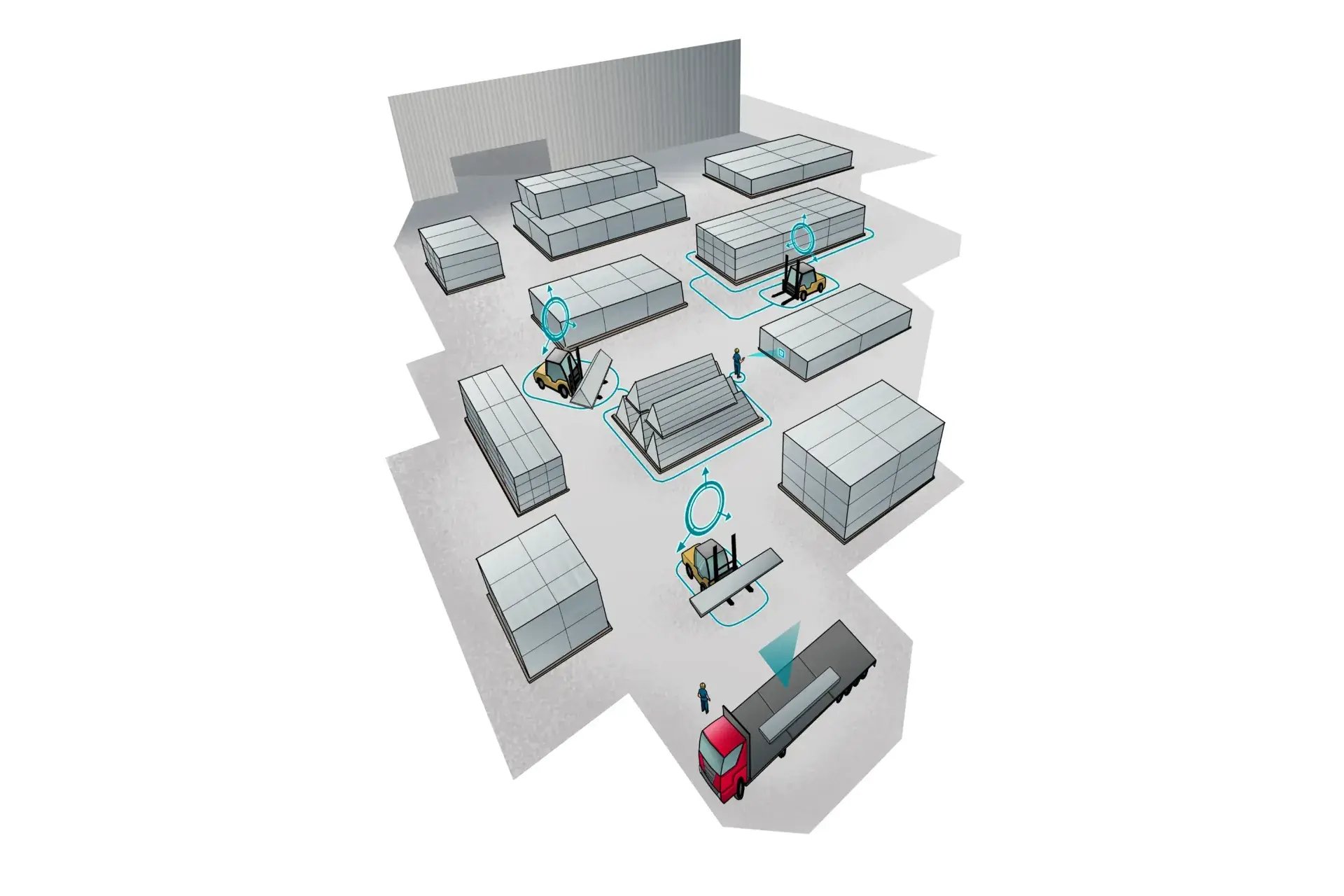
Warehouse control, traceability and organisation
- Verifying the correct position of the finished products as they leave the production line
- Enabling operators to store items in the proper slots to maximize the storage capacity
- Obtaining information for storage area optimization
- Providing the exact locations of the semi-finished product batches
Indirect location of loading units using UWB, BLE, AOA or LIDAR technology
The position of the goods is identified by knowing the position of the handling equipment (XYZ axes). The vehicles are equipped with indoor/outdoor locating technologies.
Identification of the load units is typically carried out by barcode or RFID.
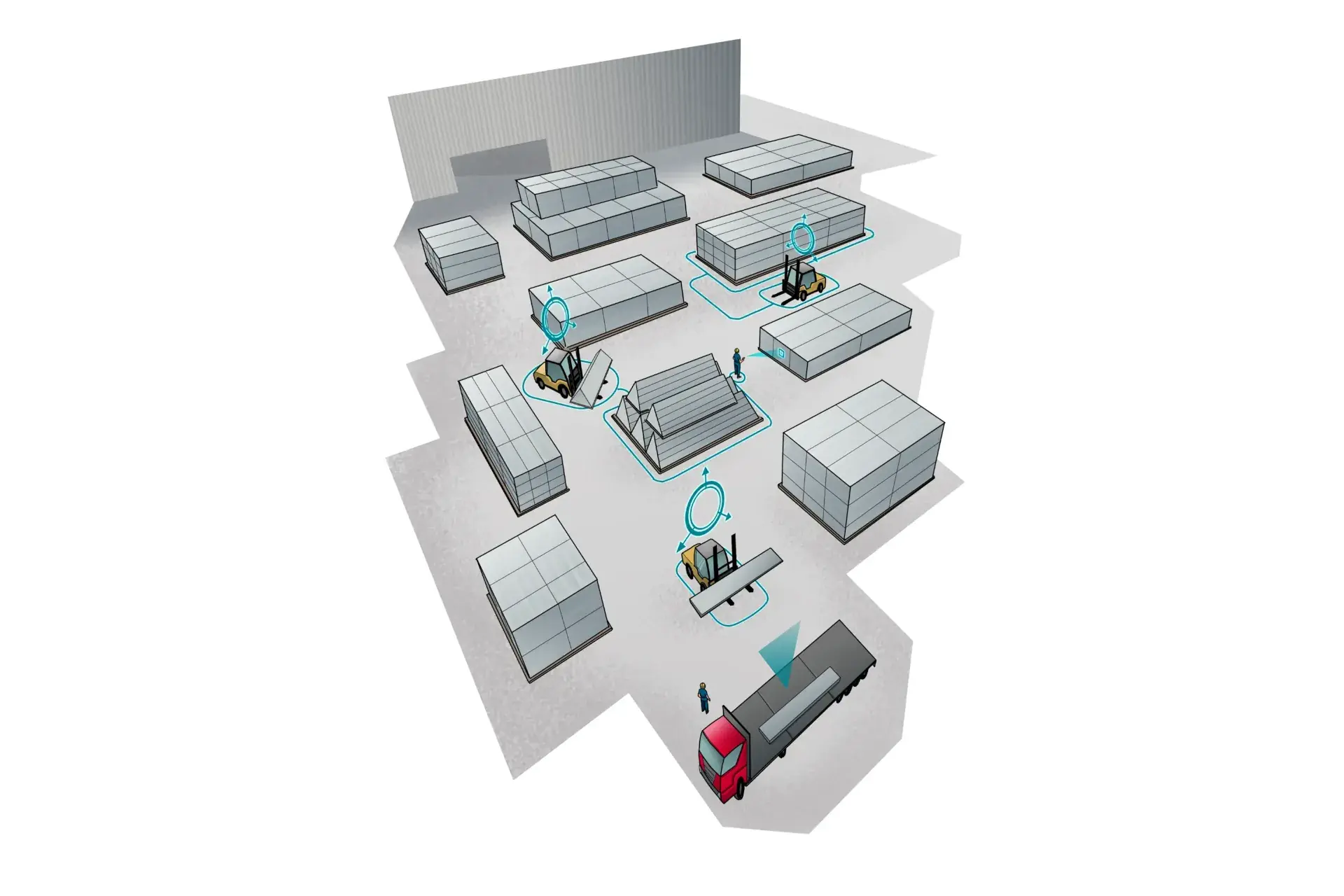
Benefits of the RTLS solution applied to indirect load unit tracking
 Reduced time spent searching for products with precise location information
 Reduced travel time of operators and transport vehicles, thanks to a better management of the storage area
FABO | Localizzazione indiretta di semilavorati, carrelli elevatori e unità di carico sulla linea di produzione
La soluzione RTLS basata su tecnologia UWB e RFiD sviluppata da Ubiquicom permette a Fabo di conoscere la posizione esatta e l’avanzamento sulla linea di produzione di ogni semilavorato e dei lotti di prodotto finito all’interno di 15.000 mq di magazzino.

Questions and insights about indoor and outdoor RTLS asset tracking
Seamless indoor and outdoor asset tracking is a solution that maintains continuous real-time visibility over assets as they move between enclosed facilities and open-air areas, without any gaps in coverage or manual handoffs.
Ubiquicom achieves this by combining UWB (Ultra-Wideband) technology indoors, which provides centimeter-level accuracy in warehouses and production buildings, with GPS outdoors for tracking assets across yards, loading areas, and open logistics zones. The transition between technologies is automatic and transparent, so operators always see a single, uninterrupted location track regardless of whether the asset is inside a building or in the open yard.
Indoor-outdoor asset tracking is valuable across a broad range of industries and asset types.
-
In manufacturing, the solution tracks raw materials, work-in-progress items, tooling, and finished goods as they move through production buildings and outdoor storage areas.
-
In logistics and warehousing, it monitors pallets, containers, forklifts, and delivery vehicles across the full distribution center campus.
-
In construction and mining, it tracks heavy machinery, tools, and materials across large outdoor sites and equipment sheds.
-
Port and terminal operators use it to track containers and handling equipment between quayside, stacking areas, and gate zones.
Any operation where assets cross building perimeters regularly benefits from this solution.
The transition between UWB and GPS is managed automatically by the Ubiquicom platform without any action required from the operator or the tracked asset user. As a tagged asset moves toward a building exit, the platform detects the weakening UWB signal and the strengthening GPS signal and seamlessly switches the positioning source.
The asset's track on the dashboard remains continuous, with no gaps or jump errors at the boundary. Transition zones near building perimeters can also be covered with BLE beacons to further smooth the handoff. The result is a clean, uninterrupted movement history that accurately reflects the asset's path through the entire facility.
Continuous indoor-outdoor tracking delivers several concrete operational benefits.
-
Asset search time is eliminated because operators can instantly locate any tagged item from the dashboard.
-
Inventory accuracy improves because the system knows the current location of all assets at all times, enabling automatic reconciliation without manual counting.
-
Process compliance is enforced through geofencing, which alerts managers when assets leave designated zones or travel unexpected routes.
-
Equipment utilization improves because idle or misplaced assets are immediately visible.
-
Maintenance scheduling becomes more accurate because actual usage hours are tracked automatically rather than estimated.
All of these benefits contribute to lower operating costs, fewer delays, and improved throughput.
Ubiquicom's indoor-outdoor tracking solution integrates multiple positioning technologies to cover every environment.
UWB (Ultra-Wideband) is the primary indoor technology, offering positioning accuracy of ±10 centimeters, which is ideal for precise warehouse and production floor tracking.
GPS provides outdoor coverage across yards, open storage areas, and inter-building transfers. BLE (Bluetooth Low Energy) can be used in transitional areas or as a complementary layer for lower-cost tracking of assets that do not require sub-meter precision.
The platform's sensor fusion engine automatically selects the best available technology for each zone, ensuring continuous coverage without operator intervention.