
RTLS-driven production cost reduction
Cost tracking and reporting in production and packaging
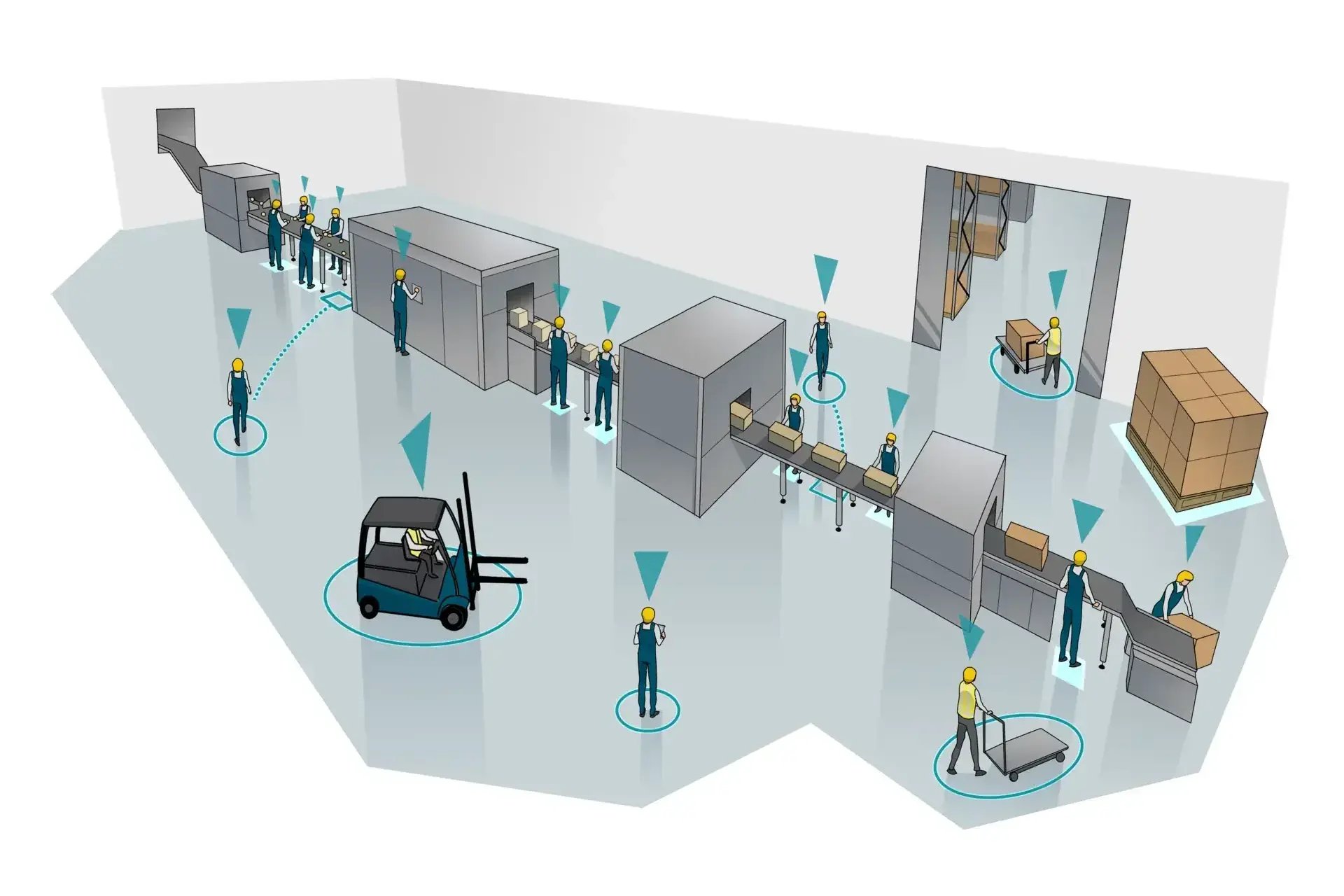
Real-time monitoring of operators, activities and equipment on production lines
- Daily man-time reports on each production lines
- Track and locate the position of operators in the production areas (with the necessary level of privacy)
- Determine how much time each operator spends at each workstation
- Manage and monitor each operator's time and job fulfillment at each workstation
- Track tools and other equipment as they move across workstations and production, lines and departments
Direct locating with MESH, BLE, or UWB thnologies
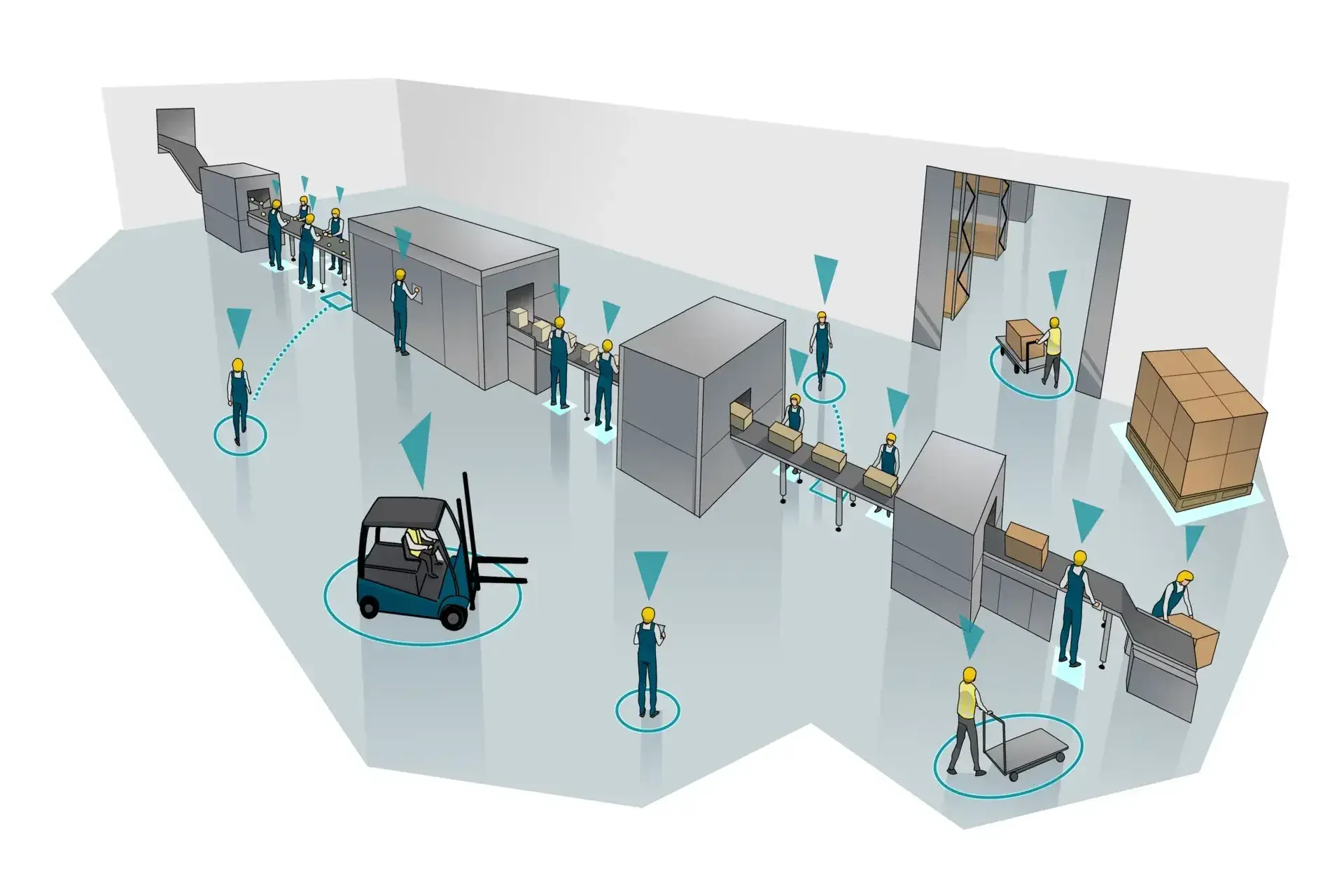
Benefits of applying the RTLS solution for production workflow optimization
 Optimize the time spent by each operator at each workstation
 Reduce labor time and costs of the production/packaging process as well as tool research
 Optimize the accounting, management control, and billing processes for complex production and packaging processes
MIVOR | IOT - RTLS solution to optimize production costs and increase productivity in an apple packaging plant

Questions and insights
RTLS reduces production costs by providing continuous, objective data on how machines, vehicles, materials, and workers are actually being used on the production floor.
This data replaces estimates and manual observations with accurate metrics, enabling management to identify and eliminate specific sources of waste.
Common cost reductions include decreased machine idle time, lower labor cost per unit produced, reduced material search and handling time, and fewer production stoppages caused by missing components or tools.
Ubiquicom's RTLS collects this data automatically in real time without disrupting production, feeding analytics dashboards that surface the most impactful improvement opportunities.
RTLS data helps identify and eliminate multiple categories of production waste aligned with lean manufacturing principles.
-
Motion waste is revealed by analyzing worker and vehicle movement paths, showing unnecessary travel distances within the plant.
-
Waiting waste appears in dwell time data showing when machines, operators, or materials are idle waiting for the next process step.
-
Transport waste is quantified by measuring how far and how often materials are moved between locations.
-
Overprocessing waste can be identified by comparing actual cycle paths against the designed process sequence.
-
Search time waste is eliminated because parts, tools, and vehicles can be located instantly.
Each of these waste types represents a quantifiable cost that RTLS data makes visible and actionable.
Ubiquicom's RTLS measures machine utilization by tracking the presence of operators, materials, and vehicles at each machine station.
When no operator is present and no material movement is occurring at a machine, the system records idle time.
This data is aggregated over shifts and production periods to calculate actual utilization rates for each piece of equipment.
When utilization rates are low, production managers can investigate whether the cause is scheduling, material supply, maintenance, or operator assignment issues. By addressing root causes identified through RTLS data, organizations typically improve machine utilization rates significantly, allowing them to increase output without adding capital equipment.
Yes, RTLS contributes to labor cost reduction in several ways.
By revealing exactly how workers spend their time, the system highlights high proportions of non-value-adding activities such as searching for tools or materials, unnecessary walking, and waiting for upstream processes. This analysis enables workflow redesign that reduces the proportion of unproductive labor time.
RTLS also supports accurate productivity measurement by recording output per operator per shift, enabling performance-based management and identification of training needs.
Additionally, improved material flow driven by RTLS data reduces the labor needed for expediting, error correction, and rework.
Together, these improvements can reduce the labor cost per unit produced without requiring headcount reductions.
RTLS analytics converts raw location data into actionable production cost insights. The Ubiquicom platform aggregates location events into structured reports and dashboards covering machine utilization, operator productivity, material flow efficiency, and vehicle usage.
Trend analysis shows whether costs are improving or deteriorating over time, and alerts notify managers when KPIs deviate from targets.
Comparative analytics allow managers to benchmark performance across shifts, production lines, or facilities.
Root cause analysis tools link cost increases to specific machines, zones, or time periods, making it straightforward to identify and address the underlying issue.
This analytics layer transforms RTLS from a location tool into a production performance management system.
RTLS is a powerful enabler of lean manufacturing and continuous improvement (CI) programs such as Kaizen and Six Sigma.
Traditional lean analysis relies on time studies and manual observations, which are labor-intensive and provide only a snapshot of performance.
RTLS provides continuous, objective data on actual process performance, enabling CI teams to identify waste with far greater speed and precision.
Before-and-after comparisons quantify the impact of improvement initiatives objectively, providing the evidence needed to justify further investment.
RTLS data also catches regression, alerting managers when process performance deteriorates after an improvement is implemented, enabling faster corrective response.
The ROI timeline for RTLS deployed to optimize production costs depends on the scale of the operation and the magnitude of existing inefficiencies, but most manufacturing deployments achieve payback within 12 to 24 months.
Cost savings typically come from multiple sources simultaneously: reduced material handling labor, improved machine utilization enabling higher throughput from existing assets, reduced tooling and equipment losses, and lower costs from process errors and rework.
In operations with significant prior waste, initial RTLS deployments often identify improvement opportunities large enough to fund the system cost within the first operating year.
Ongoing analytics continue to drive incremental improvements, extending the value of the investment over the full system lifetime.