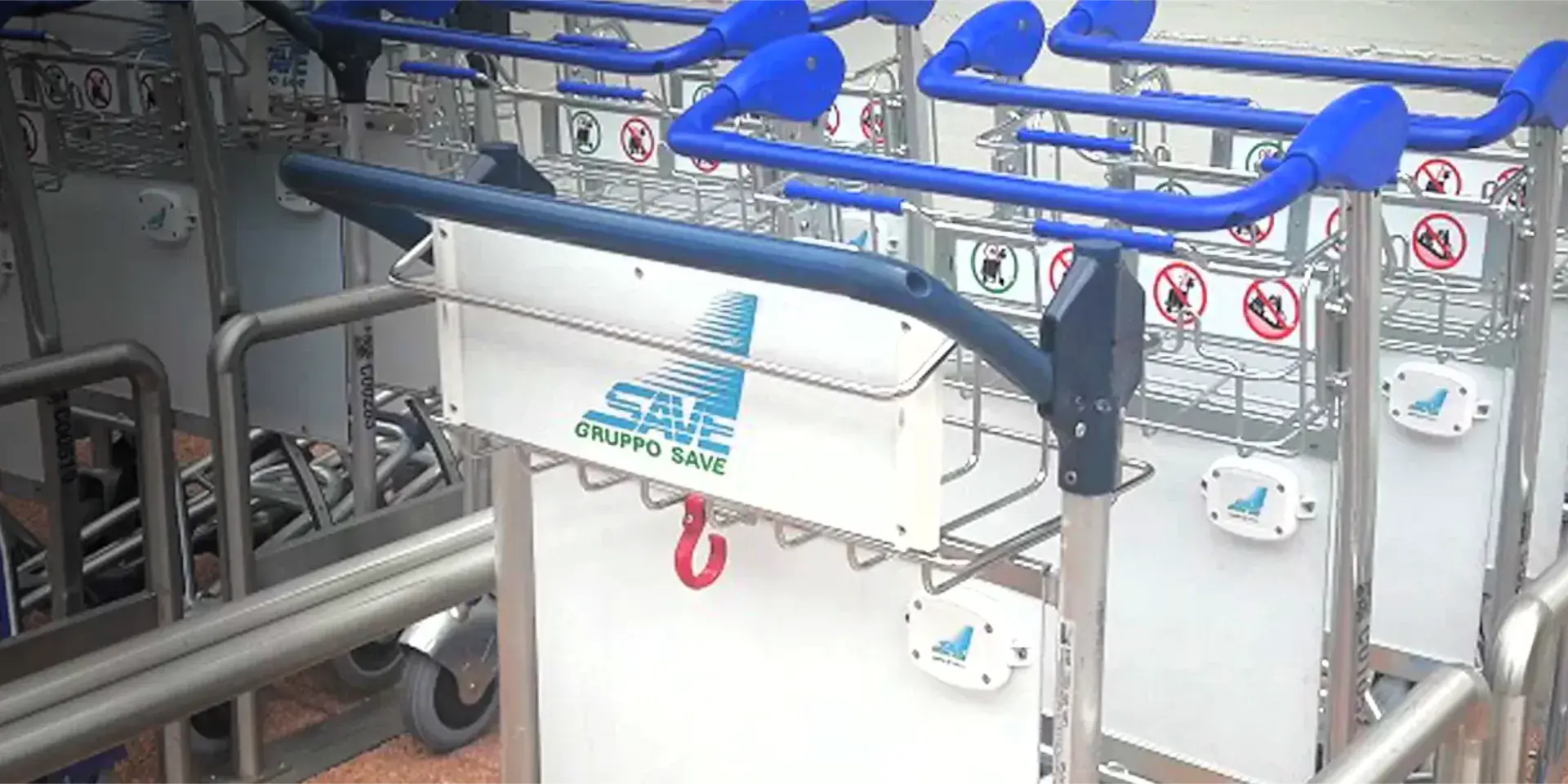
Locating luggage trolleys in airports
Tracking and optimised management of 2,200 baggage trolleys at the Venice Airport with RTLS

Teamwork for an integrated project
SAVE S.p.A., which was founded in 1987, is the holding company of a Group which operates mainly in the management of airports, in particular in the development of infrastructures and the network of flights of the Venice-Treviso System, which in 2019 exceeded more than 14 million passengers between the two airports.
THE PARTNER
Present Group is active in the ICT market along the entire value chain of IT services. The technical and functional skills present within its organization allow the design, production and management of Solutions and Services in the ICT sector to support Digital Transformation with a large and integrated offer. The services provided cover the thematic areas of Business Solutions, Managed Services and Contact Interaction Services. With approximately 1,500 employees and a turnover in 2020 of more than 100 million euros, the Present Group has a geographical presence throughout Italy and main offices in Milan, Rome, Turin, Perugia, Bologna, Padova, and Naples.
Digital monitoring of trolleys to ensure constant availability and efficient recovery in a complex airport environment
Venice airport, the third largest in Italy in terms of turnover and the fourth largest for number of passengers, has 2,200 baggage trolleys which can be freely used inside the airport buildings and in the parking areas. Special teams operate within the airport with the task of recovering trolleys abandoned by the passengers in the departures zone and in the parking areas so as to constantly guarantee the availability of a sufficient number of trolleys in each of the 25 pick-up bays. This operation was carried out on the basis of visual control and without digital support or monitoring tools.
The requirement of the company was to be able to support this activity and make it more efficient by means of an adequate tool which was able to constantly monitor the number of trolleys available in each bay and localize the abandoned trolleys throughout the entire airport area in order to guide the search and facilitate the recovery.
The characteristics of the project area were extremely complex as it consisted of very diverse zones, indoor and outdoor, on various levels, with transit ramps between the levels, various types of interference, vehicles in transit, long covered corridors and open areas without the possibility of installing antennas or power supply. The requested accuracy was linked to the possibility of identifying the trolley once it was nearby: a tolerance of a few metres was therefore tolerated. However, a good accuracy was requested in identifying the number of trolleys present in each bay.
Trolley tracking via mesh network and distributed infrastructure
Ubiquicom and Present set up a solution for direct localization of the trolleys based on the Ubiquicom Locator platform and on activetags which used the potential of the mesh networks for transmitting the field data necessary for localization towards a network of gateways distributed over the entire area and connected to the localization server, guaranteeing, at the same time, reduced consumptions.
In order to support the localization, the area was equipped with an infrastructure of approximately 500 fixed tags with the dual function of supporting the communication flows towards the gateways and providing the references for the localization. The 2,200 trolleys were equipped with a fixed tag using a shell designed ad hoc and 25 gateways were installed in the area equipped with data SIMs and powered by the mains or by means of photovoltaic panels and storage batteries.
The 2,200 tags were configured to vary the period of communication depending on the status detected by the on-board movement sensors to guarantee reduction of the consumptions when the trolley is stationary and greater localization frequency during the use. An ad hoc Web-based supervision and control interface has also been developed with all the monitoring and analysis tools required by the project. Lastly, a mobile application was developed to support the maintenance of the trolley tags and the infrastructure of fixed tags as well as for searching for the position of a specific trolley.
Increased operational efficiency thanks to fleet monitoring and faster recoveries