
Inventory Management with RTLS Innovation
How to reduce order processing time, pick errors, and improve overall operational efficiency
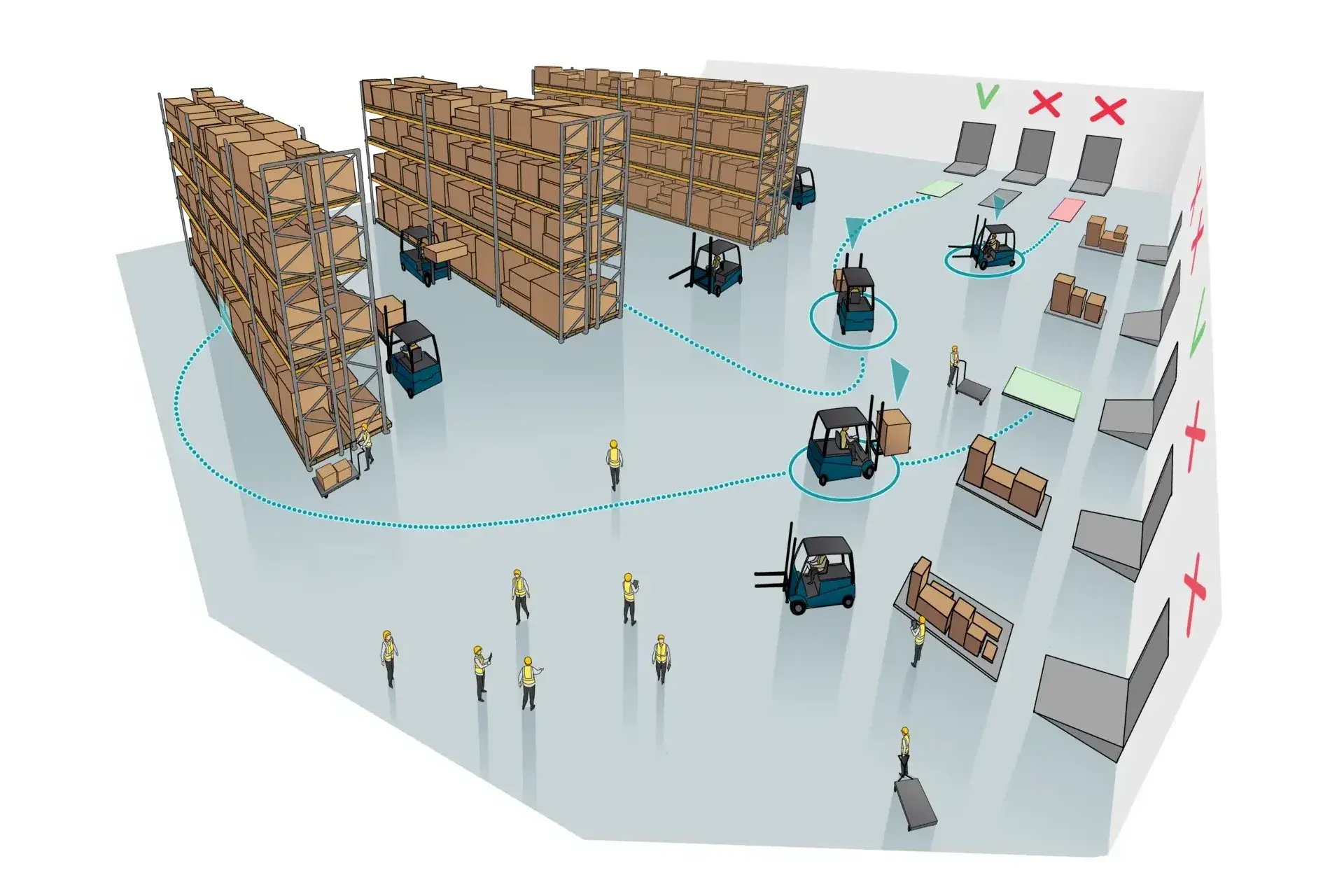
Automation of operational flows and advanced traceability to reduce errors and low-value activities
- Speed up production and logistic actions, relieving workers of those repetitive tasks with low cognitive value
- Increase automated digitalized operations to decrease human error (e.g., routing of goods in the production and logistic processes)
- Enable process transparency adding location information on top of identification of the goods carried out by barcode scans
Indirect location of loading units using UWB, BLE AOA or LIDAR technology
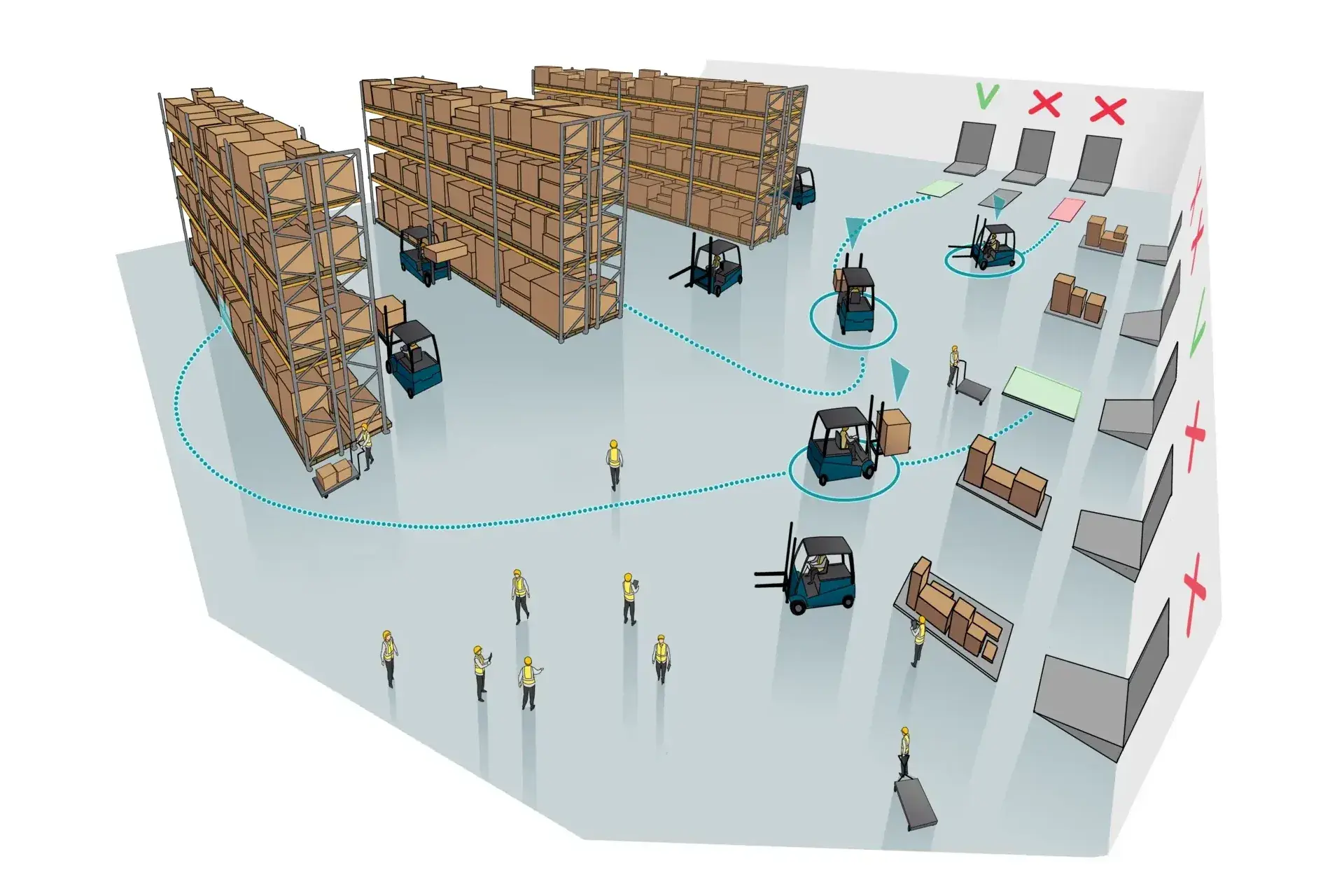
Benefits of applying the RTLS solution to inventory management and automated identification
 Increased automation and transparency reducing scanning steps and providing automatic identification and location of the goods
 Improved quality and fewer product handling faults (e.g., loading and unloading errors, inventory errors)
Questions and insights about warehouse inventory management with RTLS
Automated identification and inventory management with RTLS is a solution that uses real-time location technology combined with automatic identification (Auto-ID) to track stock levels, confirm picking operations, and maintain accurate inventory records without manual scanning or counting.
Ubiquicom integrates RFID readers and UWB positioning to automatically identify and locate inventory items as they move through a warehouse or production facility. When a tagged item passes a reader or enters a zone, the system automatically updates its location and status in the inventory record, eliminating the need for barcode scanning and reducing human error in stock management.
RFID and RTLS work together to provide both identification and location information for inventory items. RFID tags are attached to pallets, bins, or individual items and are read automatically when they pass fixed RFID gates at receiving docks, storage aisles, or dispatch points. This automatic read captures item identification without line-of-sight scanning.
RTLS technology, particularly UWB, adds precise real-time location to the identified item, so the system knows not only what an item is but exactly where it is at any moment within the facility. The combination provides inventory accuracy levels that approach 99.9% compared to typical manual counting accuracy of 65–75%, significantly reducing stock discrepancies and write-offs.
RTLS improves picking operations by guiding pickers to the precise location of the items they need and confirming each pick automatically without the need for barcode scanning.
Because the system knows the real-time position of every item in the warehouse, it can generate optimized pick routes that minimize travel distance. When a picker reaches the correct location and takes the item, the RTLS detects the movement and updates the inventory record automatically. This pick confirmation eliminates the scan step, speeding up the picking process and reducing errors caused by scanning the wrong item.
The result is higher pick accuracy, faster order fulfillment, and reduced labor cost per order.
Ubiquicom's automated identification and inventory management solution addresses several common warehouse and production inventory problems.
Stock discrepancies caused by manual counting errors are eliminated through continuous automatic tracking.
Ghost inventory, where the system shows stock that does not physically exist, is resolved because the RTLS confirms physical presence in real time.
Misplaced items that cause picking errors and stockouts are located instantly via the live map rather than requiring a physical search. Shrinkage is reduced because automated tracking creates a complete movement log for every item.
Cycle counting becomes far less disruptive because the RTLS provides a current inventory snapshot at any time without stopping operations.
Automated RTLS inventory management delivers the greatest value in industries with high stock volumes, frequent movement of goods, and a high cost of inventory errors.
Manufacturing companies use it to track raw materials, components, and work-in-progress items through production stages. Warehousing and third-party logistics providers benefit from automatic inventory updates as goods move between receiving, storage, and dispatch areas. Pharmaceutical and food distributors gain precise tracking combined with environmental monitoring to ensure compliance with storage regulations. Retail distribution centers improve order accuracy and fulfillment speed.
Any operation handling thousands of SKUs across large floor areas with frequent picking and restocking activity will see significant efficiency gains.
Ubiquicom's automated identification platform integrates with Warehouse Management Systems (WMS) and ERP systems through standard APIs and data connectors.
Location and identification events generated by the RTLS and RFID layer are translated into inventory transactions that update stock records in the WMS or ERP in real time. This means that warehouse management and enterprise planning systems always reflect the current physical state of inventory without requiring manual data entry. Integration reduces reconciliation work, improves demand planning accuracy, and ensures that order management systems have reliable stock availability data to promise accurate delivery dates to customers.
Organizations implementing automated RTLS inventory management can measure ROI across several indicators.
-
Inventory accuracy typically improves from 75-85% (with traditional manual methods) to 98-99.5%, directly reducing costly stock discrepancies and emergency replenishment orders.
-
Labor cost per inventory transaction decreases significantly because automatic identification replaces manual scanning and counting.
-
Order picking errors drop, reducing the cost of returns, reshipments, and customer service escalations.
-
Warehouse throughput increases because pickers spend less time searching and more time moving goods.
-
Lost or misplaced inventory is virtually eliminated.
Collectively, these gains typically deliver a full return on investment within one to two years of deployment.