
Production workflow optimization with RTLS
How to track the replenishment of production lines and avoid production line shutdowns
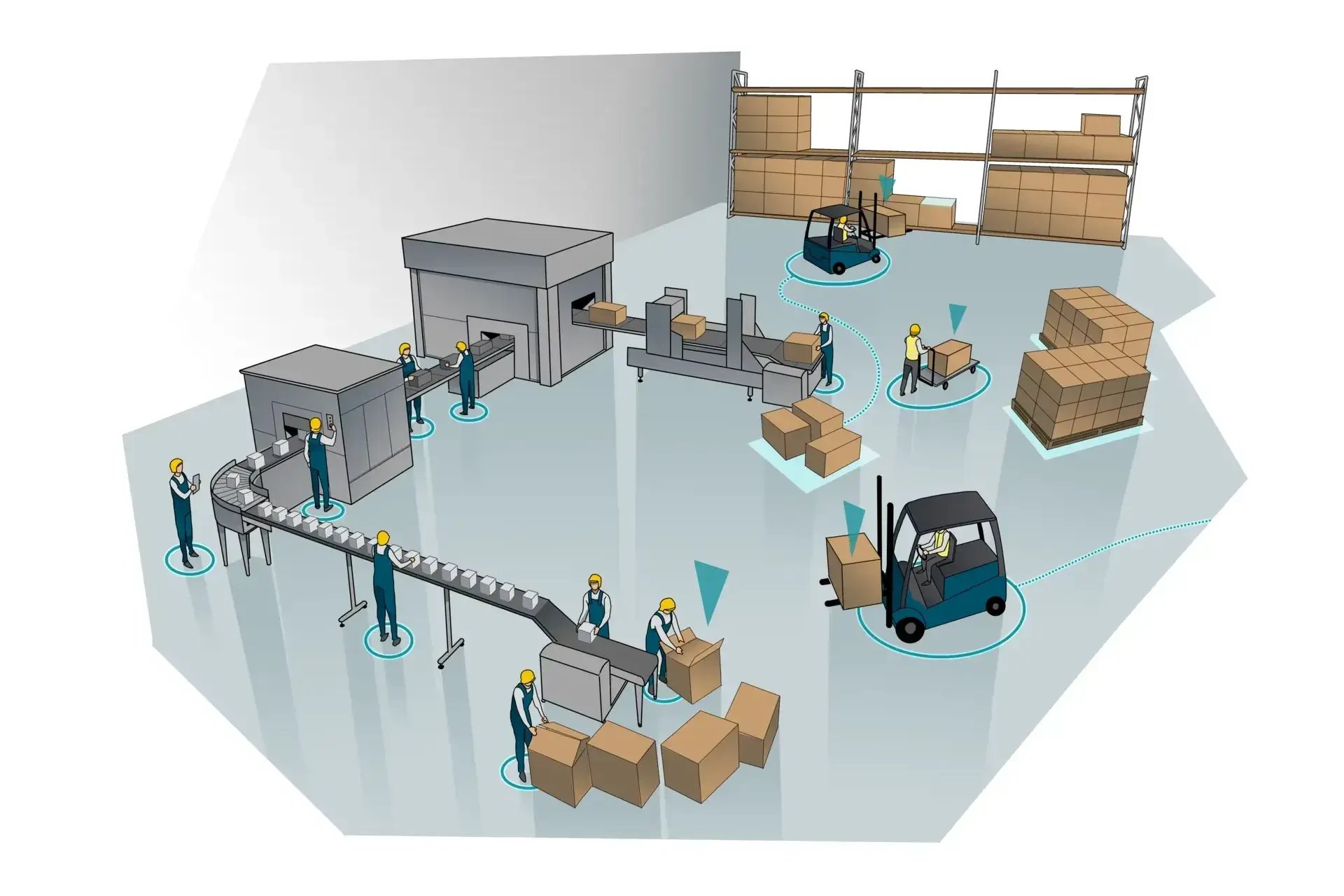
Shop floor optimisation with live monitoring and automated replenishment
- Increase the visibility of the production process and material flows to identify improvement opportunities
- Enable automated replenishment policies monitoring in real-time the safety stock tracking the cases available at each processing station
- Optimize material flows (replenishment, end-of-line, empty cases) and material handling by the operators on the production floor
Direct locating using UWB or BLE technology
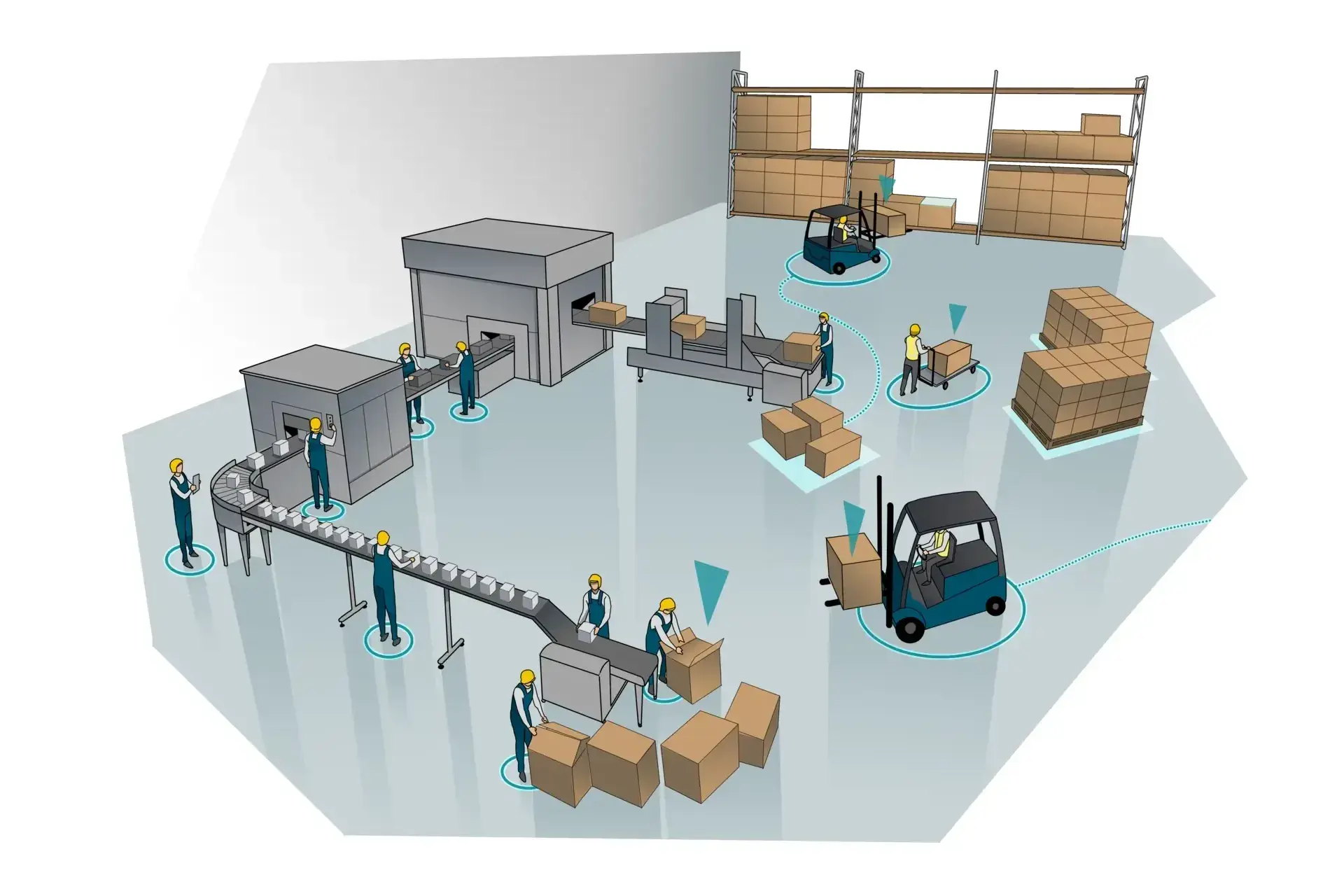
Advantages of the RTLS solution applied to the optimisation of production line replenishment processes
 Improved efficiency by reducing scanning steps, automating replenishment activities, and optimizing material and operator flows
 Increased process transparency and reliable data to support continuous improvement and total quality processes
Questions and insights
RTLS optimizes production workflows by providing real-time, objective data on how materials, operators, vehicles, and work-in-progress items flow through each stage of the manufacturing process.
Ubiquicom's system tracks every tagged asset as it moves between workstations, buffer zones, and production cells, building a continuous digital record of actual process flow. This data reveals where flow deviates from the designed sequence, where queues build up, and where handoffs between stages are delayed.
Managers can use this information to redesign workflows, reassign resources, and implement targeted fixes that smooth the flow of production and reduce total lead time from raw material input to finished product output.
RTLS workflow optimization delivers the greatest benefit in manufacturers with complex, multi-stage production processes involving significant material movement between stations.
Automotive manufacturers and their suppliers benefit from RTLS in assembly line sequencing and just-in-time component delivery.
Electronics manufacturers use it to track PCB assemblies through multiple soldering, testing, and inspection stages.
Aerospace manufacturers track high-value sub-assemblies through long production cycles.
Food processors monitor batch movement through filling, cooking, cooling, and packaging sequences.
Any manufacturer with high production floor complexity, frequent production changeovers, multiple product variants, or significant work-in-progress inventory will gain measurable workflow improvements from RTLS deployment.
A production bottleneck is a point in the process where capacity is insufficient to match the flow rate required by upstream and downstream stages, causing queue buildup and delays.
RTLS enables bottleneck detection by measuring dwell time at each workstation or zone. When work-in-progress items consistently accumulate and wait longer than expected before a specific process step, the system flags that location as a bottleneck.
Real-time alerts can notify production supervisors when queue depth exceeds a defined threshold. Historical trend analysis identifies whether a bottleneck is chronic or triggered by specific conditions such as shift changes, specific product types, or machinery performance degradation.
This pinpointed insight allows targeted interventions rather than broad and costly capacity expansions.
Flow balancing aims to distribute work evenly across all stages of a production line so that no station is overloaded while others are underutilized.
RTLS supports flow balancing by measuring actual cycle times and throughput rates at each station based on observed material movement. These measurements replace time study estimates with live performance data that reflects real conditions including operator variability, maintenance events, and material supply fluctuations.
With accurate per-station cycle time data, industrial engineers can calculate precise takt times, identify imbalances, and reallocate tasks or resources to level the line.
Material flow sequencing requires that components and sub-assemblies arrive at each production station in the correct order and at the correct time.
RTLS improves sequencing by providing real-time visibility into where every part or batch currently is within the production system. When a required component is delayed or has deviated from its intended path, the system generates an alert so the production team can expedite or redirect it before a line stoppage occurs.
For mixed-model production lines where multiple product variants are assembled simultaneously, RTLS ensures that the correct variant-specific components are routed to the correct station, preventing mis-sequencing errors that cause rework and disruption.
Yes, RTLS is a direct enabler of lean manufacturing implementation. The core lean principle of eliminating waste requires accurate measurement of where waste occurs, and RTLS provides this measurement continuously and automatically.
Motion waste, transport waste, waiting waste, and work-in-process inventory waste are all quantified through location data analysis.
For Just-in-Time (JIT) production, RTLS supports material flow timing by alerting operators when components are not arriving at workstations within the planned delivery window, enabling immediate corrective action to prevent production stoppages.