
Handling of semi-finished products
RTLS systems provide more effective internal handling of semi-finished or finished goods (coils, bars, tubes, etc.).
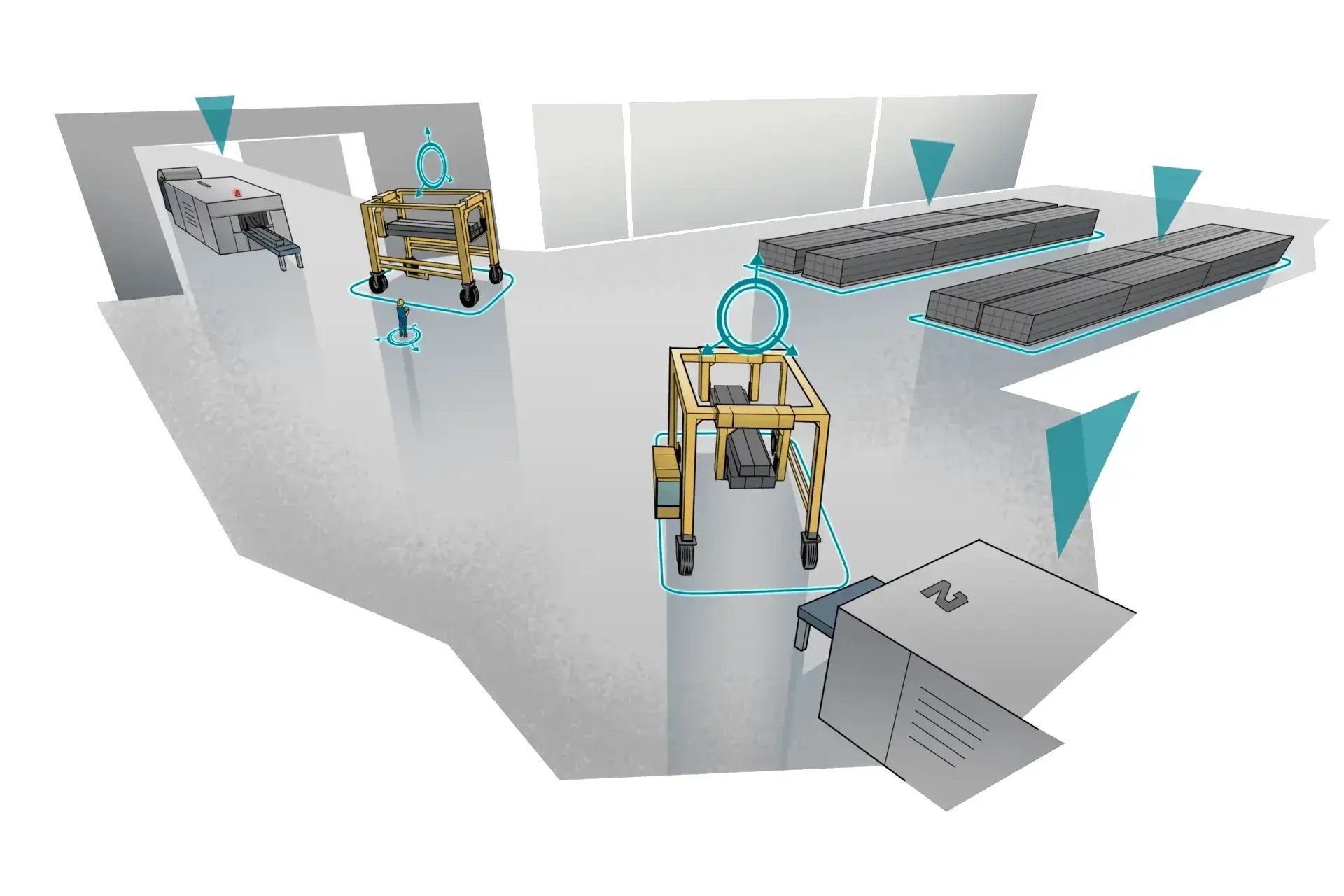
Real-time tracking and end-to-end visibility of semi-finished and finished products
- Real-time visibility of the semi-finished product warehouse
- Locating and tracking semi-finished products through production lines
- Tracking the location of finished products to optimize the manufacturing process and the loading activities during the product shipment process
Indirect location of loading units
The position of the goods is identified by knowing the position of the handling equipment (XYZ axes). The vehicles are equipped with indoor and outdoor localization technologies.
Identification of the load units is typically carried out by barcode or RFID.
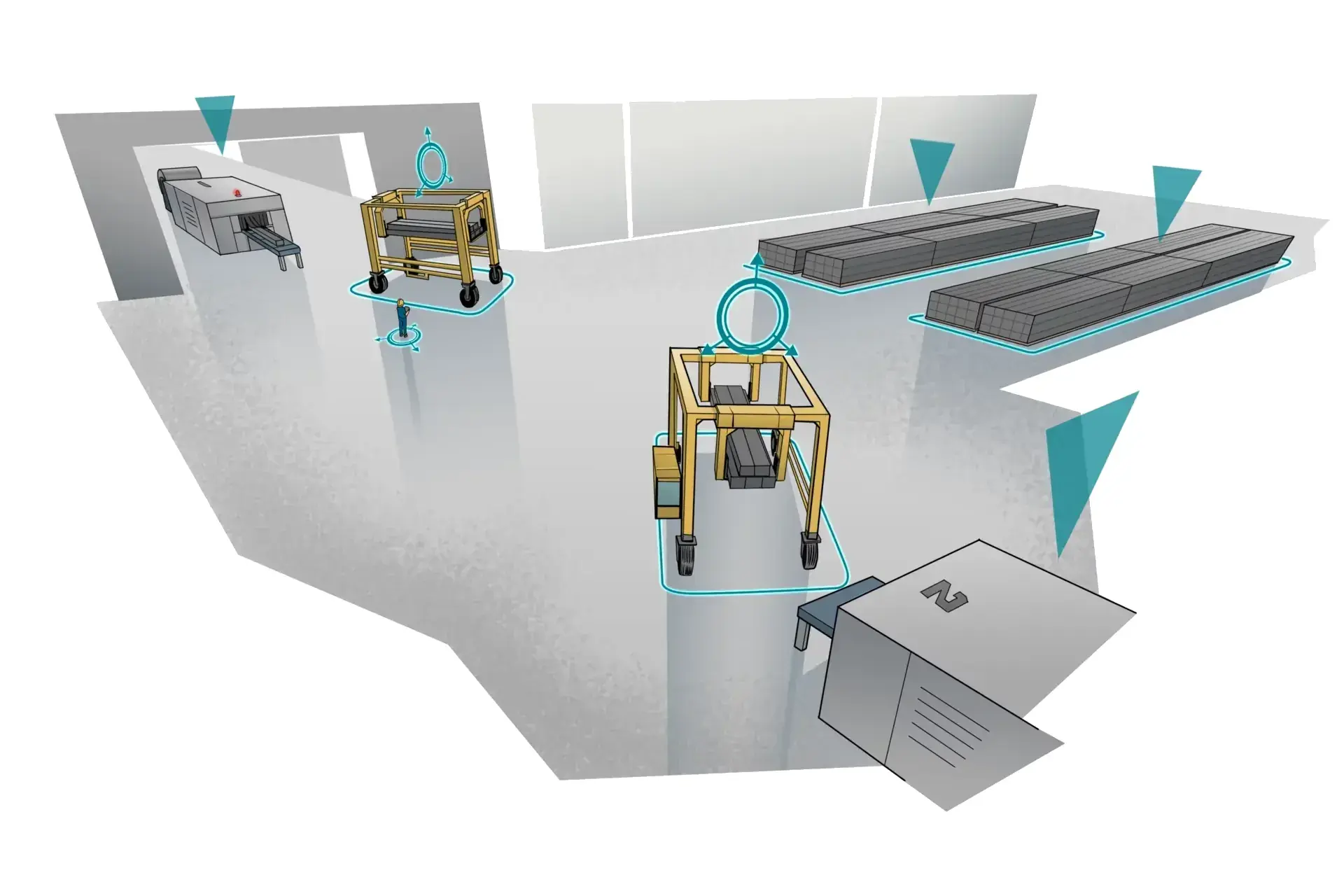
Benefits of applying the RTLS solution to internal handling of semi-finished products
 Reducing material search time through asset positioning
Reducing handling times by optimizing flows between processing stages
Reducing material search time through asset positioning
Reducing handling times by optimizing flows between processing stages
 Reducing time and errors in product shipment
 Reducing errors in finished product assembly
Questions and insights
RTLS-based tracking for semi-finished products is a solution that monitors work-in-progress (WIP) items as they move through each stage of the production process, from raw material processing through intermediate manufacturing steps to final assembly.
Tracking is performed attaching compact tracking tags to WIP containers, pallets, or assemblies. As these items move between workstations, buffer zones, and production cells, the system records their position and movement history automatically.
This real-time visibility eliminates the common problem of not knowing where a specific semi-finished item is within the production flow, reducing search time, preventing production stoppages caused by missing components, and improving the accuracy of production status reporting.
Semi-finished products are among the most difficult assets to track in a manufacturing environment because they move frequently, often through complex multi-stage sequences, and may wait in informal buffer zones between process steps.
Unlike finished goods, which have defined storage locations, WIP items are in constant transition and can accumulate in unexpected places when production flow is disrupted.
Without RTLS, operators must rely on manual status updates, paper travelers, or periodic barcode scans to know where an item is, and these methods quickly fall out of synchronization with reality. The result is significant time spent searching for missing WIP, inaccurate production status reporting, and reactive management of production stoppages instead of proactive flow control.
RTLS eliminates WIP search time by providing the current location of every tagged semi-finished item on a live digital map accessible from any terminal or mobile device.
When a worker or supervisor needs to locate a specific batch or sub-assembly, they simply query the system by item ID or batch number and are shown its exact location within the facility. This replaces the common practice of physically walking the production floor or asking multiple workers if they have seen a specific item.
In large plants with dozens of workstations and buffer areas, search time for a misplaced semi-finished item can easily exceed 30 minutes. RTLS reduces this to seconds, recovering significant productive time across the workforce.
Accurate knowledge of where every WIP item is within the production sequence gives production schedulers real data to work with instead of estimates.
Schedulers can see which orders are on track, which are delayed and at which stage, and how much WIP inventory is queued at each workstation. This visibility allows more accurate delivery date commitments to customers and faster reaction when delays are detected.
When a semi-finished item is identified as late, the system can alert the responsible supervisor immediately, enabling corrective action before the delay propagates to final assembly.
RTLS enforces production sequence compliance by verifying that semi-finished items visit the required process stations in the correct order.
The system compares each item's actual location history against its defined routing and flags deviations in real time. If an item moves directly from station A to station C without passing through station B, where a mandatory process step or quality inspection takes place, the system generates an alert immediately. This prevents non-conforming products from reaching later production stages where additional value is added before the defect is discovered.
For quality-regulated industries such as aerospace, medical devices, or automotive, this sequence enforcement provides documented evidence that process requirements were met for every unit produced.
RTLS WIP tracking delivers the greatest value in industries with multi-stage production processes, high product complexity, or strong regulatory traceability requirements.
-
Automotive manufacturers and Tier 1 suppliers track sub-assemblies through complex build sequences.
-
Aerospace manufacturers monitor high-value components through long production cycles with mandatory quality checkpoints.
-
Electronics manufacturers track PCBs and assemblies through soldering, inspection, and testing stages.
-
Metal processing and fabrication plants monitor parts through cutting, forming, heat treatment, and finishing sequences.
-
Pharmaceutical manufacturers track batches through granulation, tableting, coating, and packaging stages.
Any manufacturer where losing or missequencing a WIP item causes costly rework, line stoppages, or compliance failures will benefit significantly from RTLS WIP tracking.
Ubiquicom's RTLS integrates with Manufacturing Execution Systems (MES) to create a unified production visibility layer.
Location events for WIP items are passed to the MES as automatic work order status updates, so the MES always reflects the current state of every active production order without requiring manual scan entries.
The MES can trigger RTLS-based alerts when a WIP item has not arrived at its next scheduled workstation within the expected timeframe, enabling proactive flow management.
Quality hold status can be propagated from the MES to the RTLS, causing the system to alert operators if a held item is moved before the hold is released.
This bidirectional integration makes both systems more valuable and reduces the manual data synchronization effort for production control teams.