
Tracking of vehicles and luggage in airport cargo areas
How to optimize the handling of goods and luggage at the airport through the location of cargo dollies
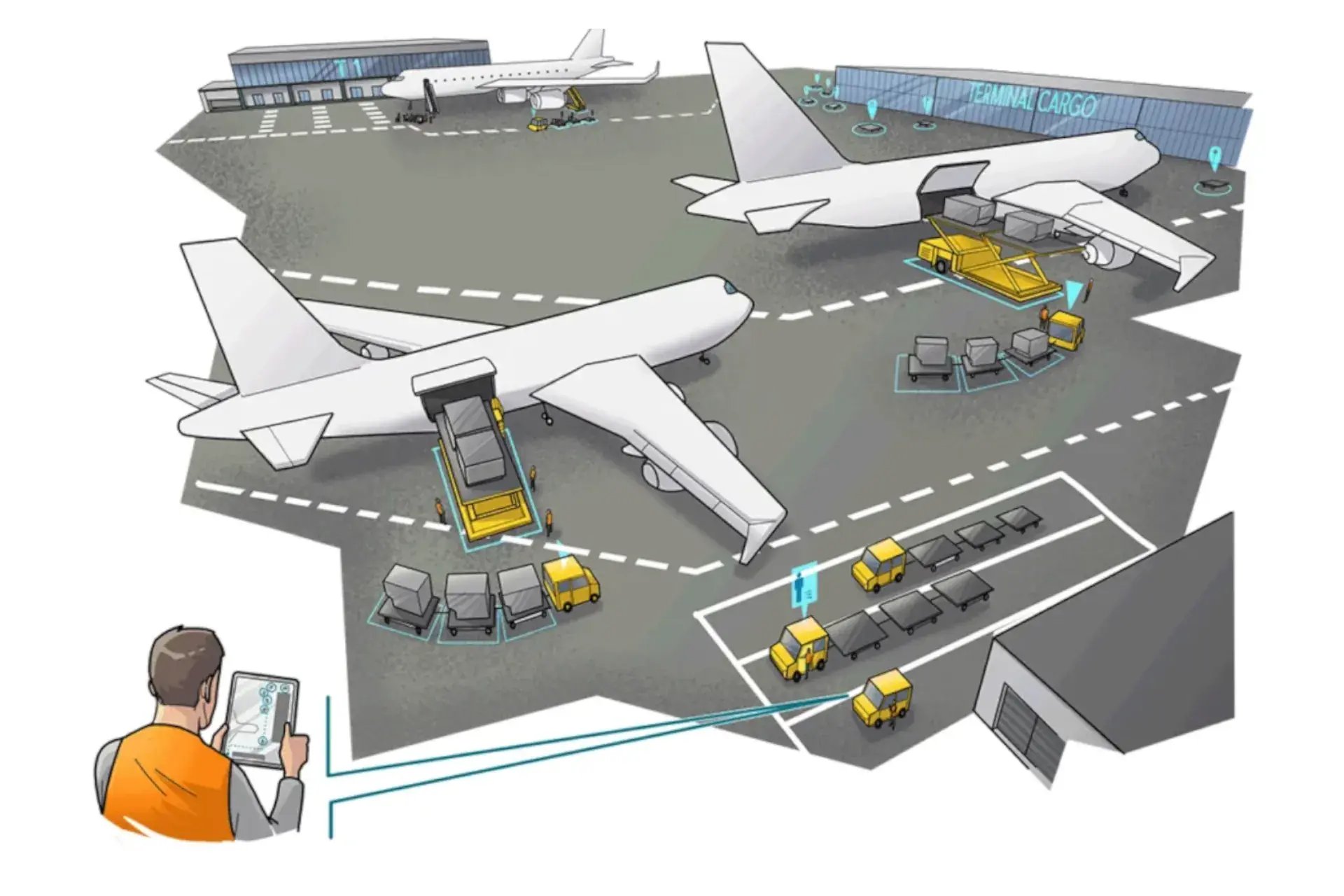
Optimising the handling of goods and baggage at airports
Vehicle and asset tracking within the airport grounds
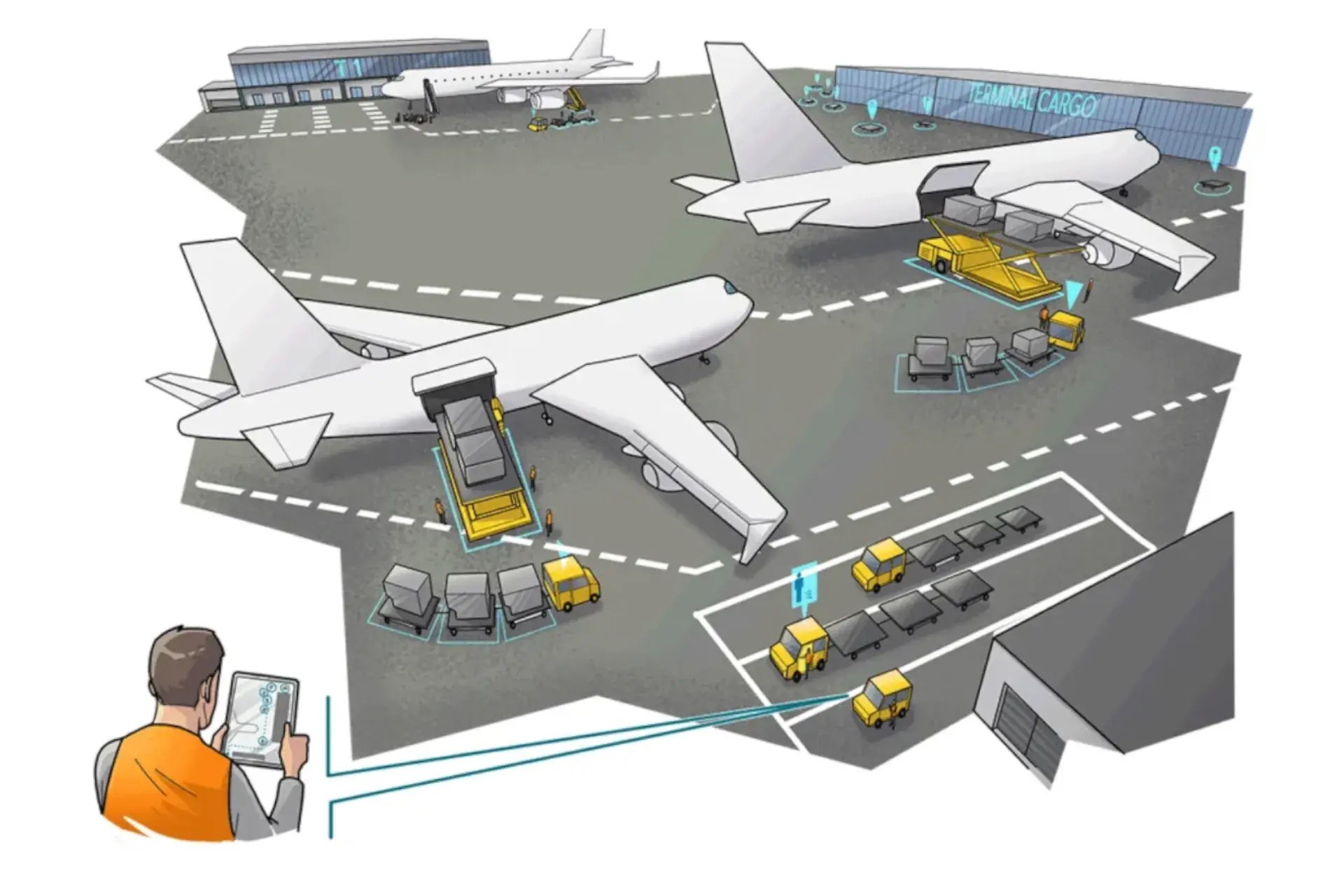
The tracking of vehicles and assets is carried out through GPS BLE or 2G / 4G technologies. Communication is established via 2G / 4G mobile technology.
.
Benefits of applying the RTLS solution to airport cargo handling
 Reducing vehicle search times and optimizing assignments to operators through positioning within the map available
Reducing handling times through the optimization of flows between different areas
Reducing vehicle search times and optimizing assignments to operators through positioning within the map available
Reducing handling times through the optimization of flows between different areas
 The capacity to identify and keep track of operating characteristics and use information
Optimization of handling activities in air cargo areas
The solution uses a combination of technologies (GNSS and BLE) and location logics (direct and indirect) of dollies and trailers for container transport to improve cargo loading/unloading and fleet management efficiency and safety.

Questions and insights
RTLS (Real-Time Location System) for airport cargo handling is a technology solution that tracks cargo, handlers, and equipment in real time across the air freight terminal.
Ubiquicom's RTLS uses UWB (Ultra-Wideband) technology to achieve positioning accuracy of ±10 centimeters, enabling airports and cargo operators to know the precise location of every shipment, pallet, and vehicle on the ramp and in the warehouse at any moment. Tags attached to cargo units and equipment continuously communicate with a network of fixed anchors, feeding live data into a centralized dashboard.
Air cargo terminals face persistent challenges including misrouted shipments, delayed loading, idle ground support equipment, and manual processes that cause errors and slowdowns.
RTLS eliminates cargo misrouting by providing real-time location verification at every transfer point. It reduces loading delays by alerting handlers when cargo has not moved within the expected timeframe, and it eliminates the time wasted searching for misplaced units or equipment. Automated handoff confirmation replaces paper-based or radio-based communication, reducing errors and accelerating the entire cargo flow from inbound receipt to aircraft loading.
Ubiquicom employs UWB (Ultra-Wideband) as the primary positioning technology for indoor areas such as cargo warehouses and terminals, delivering centimeter-level accuracy. For outdoor ramp areas, the system integrates GPS to maintain continuous tracking across the full airport environment. BLE (Bluetooth Low Energy) and RFID can be combined with UWB for access control points and automated cargo identification at checkpoints.
This multi-technology approach ensures that a shipment is tracked seamlessly from warehouse receipt through ramp transfer and onto the aircraft without any visibility gaps.
Ubiquicom's RTLS can track a wide range of assets in an airport cargo environment. These include Unit Load Devices (ULDs) such as containers and pallets, individual high-value or time-sensitive shipments, forklifts and cargo loaders, baggage tractors and dollies, and personnel including cargo handlers and ground crew.
The system can also monitor vehicles such as trucks entering or exiting the airside zone.
By tagging all relevant assets, the system provides a complete operational picture of the cargo terminal in a single real-time view.
Airports and cargo handlers implementing RTLS typically achieve significant improvements across multiple KPIs.
Cargo search time is reduced dramatically, often by 60% or more, because handlers can locate any shipment instantly from the dashboard rather than performing manual searches.
On-time departure rates improve as real-time alerts flag cargo that is not progressing through the handling sequence on schedule.
Equipment utilization improves because idle or misplaced ground support equipment is immediately visible, reducing the need for excess inventory.
Overall, RTLS delivers measurable gains in throughput, compliance documentation, and cargo security.
Ubiquicom's RTLS platform is designed to integrate with existing Cargo Management Systems (CMS), Warehouse Management Systems (WMS), and flight operations software through standard APIs. Location events generated by the RTLS are matched to shipment records in the CMS, enabling automatic status updates without manual scanning.
Integration with flight schedule data allows the system to prioritize handling queues based on departure times. This interoperability means airports do not need to replace their existing IT infrastructure but instead enhance it with real-time location intelligence.
Yes, Ubiquicom's RTLS solution is scalable and can be deployed in airports of any size.
Large international cargo hubs benefit from the system's ability to manage thousands of tracked assets simultaneously across multiple buildings, ramp zones, and terminals.
Regional airports and smaller cargo facilities benefit from the ability to implement a right-sized deployment covering their specific terminal footprint, with the option to expand coverage as operations grow.
The modular architecture means the system can start with a focused use case, such as ULD tracking, and expand to full ground support equipment and personnel tracking over time.
RTLS contributes to safety and regulatory compliance in airport cargo operations in several ways.
Geofencing capabilities generate instant alerts when personnel or vehicles enter restricted airside zones without authorization, supporting security compliance.
The system logs all movement events with timestamps, creating a full audit trail that satisfies customs and regulatory documentation requirements.
For dangerous goods and pharmaceutical cargo, real-time location combined with environmental sensors ensures that these shipments remain within approved handling zones and conditions throughout their time at the airport. This documentation capability significantly simplifies compliance reporting and incident investigation.