
Real-time locating of assets in the airports
Optimization of handling and tracking procedures of mobile assets (trolleys, wheelchairs, baggage carts, and other equipment) within airport areas
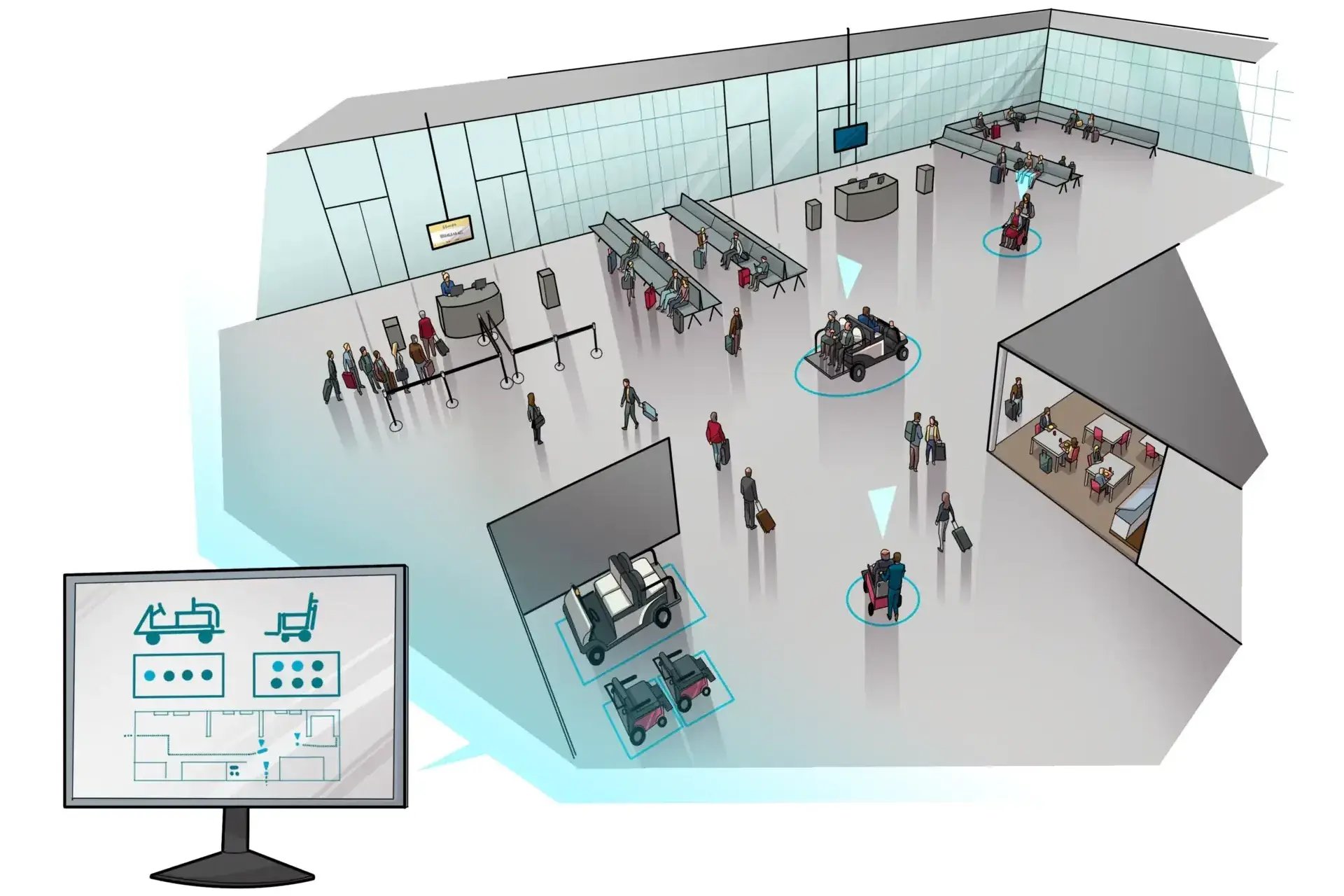
Continuous monitoring and advanced traceability of dollies with historical data for assets
Asset locating using uMESH technologies
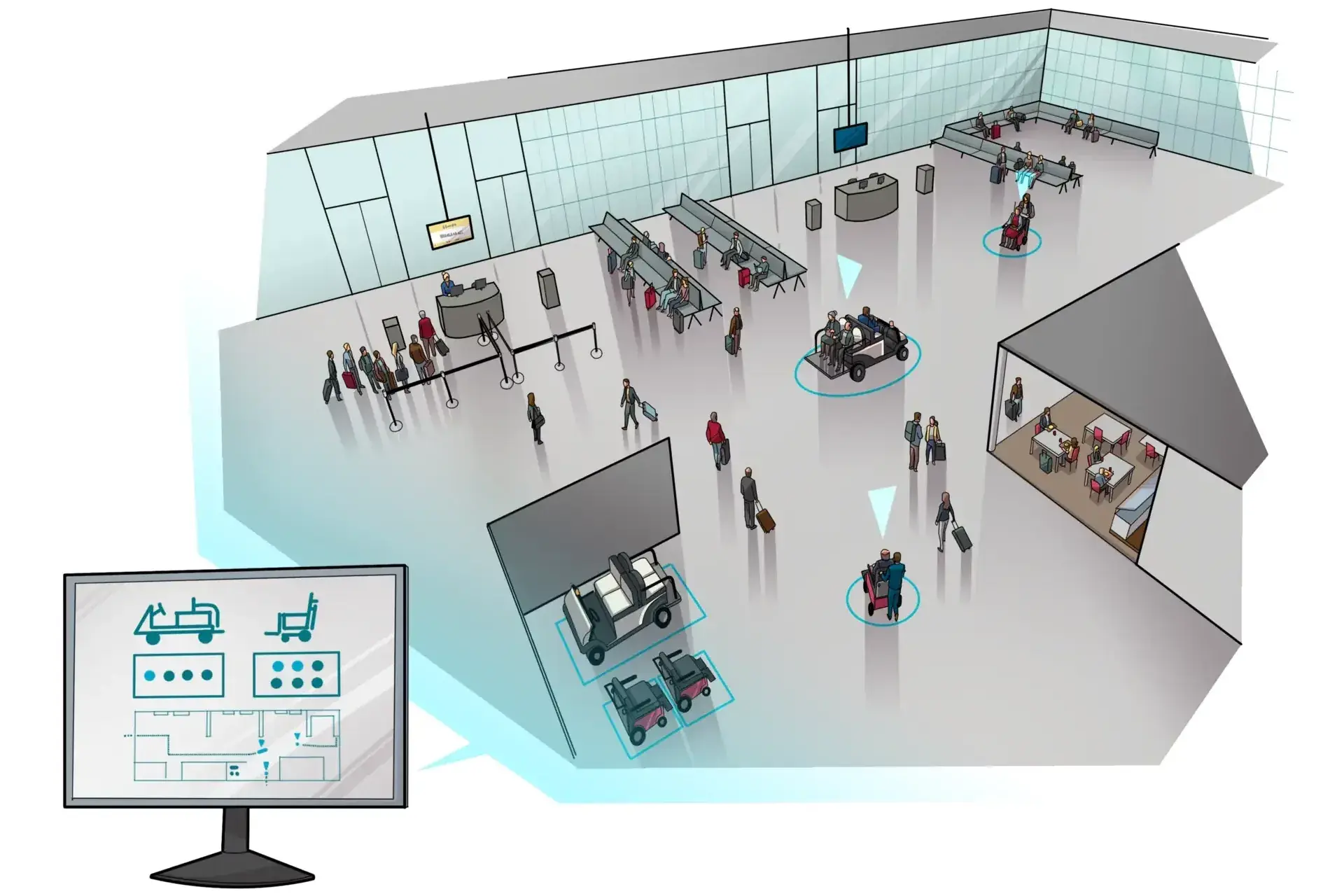
Benefits of applying the RTLS solution to airport logistics
 Reducing asset search times for operators through position identification on the map
Handling times through flow optimization between different areas
Reducing asset search times for operators through position identification on the map
Handling times through flow optimization between different areas
 Increasing service quality based on aircraft arrival and departure scheduling
 Enhancing the standard of services provided to visitors by monitoring traffic and analyzing historical data to find and fix important problems
SAVE GROUP | Tracking and optimised management of 2,200 luggage trolleys at the venice airport with rtls
The solution for tracking and locating luggage trolleys improves the efficiency of workers in finding the trolleys and provides a prompt service to the millions of passengers that transit through Venice airport.

Questions and insights about RTLS asset tracking in airport operations
Airport logistics asset tracking with RTLS is a real-time location solution that monitors the position and status of all movable assets across an airport campus. This includes baggage carts, dollies, passenger boarding stairs, ground power units, aircraft tugs, and other ground support equipment (GSE).
Ubiquicom's system attaches small tracking tags to each asset and uses a network of UWB or BLE anchors to determine precise positions in real time.
The resulting live map gives operations managers full visibility over every asset at any moment, eliminating the time wasted searching for missing or idle equipment.
Ubiquicom's airport asset tracking system can monitor a comprehensive range of ground support equipment.
Tracked asset categories include baggage carts and dollies, passenger boarding bridges and stairs, ground power units and air starters, aircraft tugs and pushback tractors, belt loaders and cargo loaders, lavatory and water service vehicles, fueling equipment, and de-icing units.
The system is also applicable to smaller assets such as tool kits, passenger wheelchairs, and equipment used by ground handling crews. Any asset that can accept a compact tracking tag can be incorporated into the monitoring network.
Equipment losses and underutilization are major cost drivers for airport ground handlers. RTLS addresses both problems by providing continuous, real-time visibility into where every asset is located and whether it is in use or idle.
When equipment is not returned to its designated parking zone after a turn, the system sends an automatic alert to the dispatcher. Usage data captured over time reveals patterns of over- or under-deployment, allowing fleet managers to right-size their GSE inventory.
Airports implementing RTLS typically reduce asset search time by over 50% and can identify opportunities to reduce fleet size by eliminating redundant equipment that was previously purchased to compensate for poor visibility.
Ubiquicom uses UWB (Ultra-Wideband) technology as the primary positioning engine for indoor airport environments such as terminals, baggage halls, cargo warehouses, and enclosed maintenance bays. UWB delivers positioning accuracy of ±10 centimeters, which is sufficient to determine not just which building or zone an asset is in, but its precise location on the apron or within a room.
For large outdoor apron and parking areas, GPS tracking is integrated to maintain continuous coverage. BLE (Bluetooth Low Energy) beacons can supplement the network for lighter-duty tracking requirements or in areas where ultra-precise accuracy is less critical.
Yes, RTLS significantly enhances apron safety.
Geofencing rules can define exclusion zones around active aircraft, generating immediate alerts if a vehicle or person enters the zone without authorization.
The system can also enforce speed limits for vehicles in specific areas by analyzing movement patterns and flagging violations.
Integration with Ubiquicom's collision avoidance technology extends safety coverage to include vehicle-to-vehicle and vehicle-to-person proximity warnings.
This layered approach reduces the risk of ramp incidents, which are among the most costly safety events in the aviation industry.
The return on investment from airport RTLS asset tracking comes from several sources.
-
First, reduced search time for equipment translates directly into lower labor costs and faster aircraft turnarounds.
-
Second, improved asset utilization means fewer units are needed in the fleet, reducing capital expenditure on new equipment and maintenance costs for excess assets.
-
Third, better documentation of equipment usage supports accurate billing for handling contracts and reduces disputes.
-
Fourth, improved apron safety reduces the frequency and cost of ground damage incidents, which represent one of the largest uninsured cost categories in aviation ground operations.
Most deployments achieve a positive ROI within 12 to 18 months.
Ubiquicom's RTLS platform integrates with existing airport operations software through open APIs and standard data formats. Connections can be established with Airport Operational Databases (AODB), Ground Handling Management Systems, Maintenance Management Systems (MMS), and ERP platforms.
Real-time location data enriches flight information by linking equipment movements to specific flight numbers, enabling automated resource planning aligned with the flight schedule. The system can also feed data into third-party analytics and reporting tools, allowing airport operations teams to incorporate RTLS data into their existing business intelligence workflows without replacing incumbent systems.