Skip to content
RTLS solutions for logistics, manufacturing, transportation

RTLS solutions to boost efficiency of logistics and manufacturing processes

RTLS and Artificial Intelligence technologies to maximize operational efficiency and optimize logistics flows for industries, warehouses, transportation, and many other sectors.

RTLS solutions for companies

UBIQUICOM is specialized in the design and development of innovative products and solutions for the locating and tracking of people and assets, designed to increase efficiency and safety in the supply chain business processes.

A one-stop-shop platform aimed at large enterprises to support a wide range of use cases. The systems provide process visibility, automation, and orchestration, leveraging Artificial Intelligence and relying on multiple real-time locating technologies. Our systems provide vertical solutions that address industry-specific pain points by combining location information and industry logic.

The company’s competitive advantages lie in:

  • A deep, state-of-the-art know-how of RTLS Real-Time Locating Systems and enabling technologies;
  • A set of unique, patented solutions;
  • Reliability demonstrated through severalthousand customer installations;

Gartner projects the indoor location services market to reach $55 billion in revenue by 2030, up from $1.9 billion in 2021.

Use cases

RTLS solutions by industry

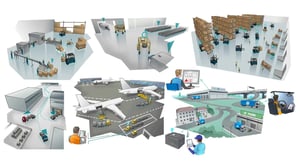
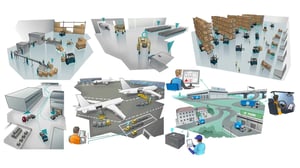
A non-exhaustive collection of use cases showcasing how RTLS can enhance business processes, efficiency, and safety in logistics, manufacturing, transportation, and other industries.
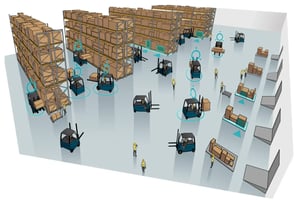
RTLS solutions for logistics, manufacturing, transportation
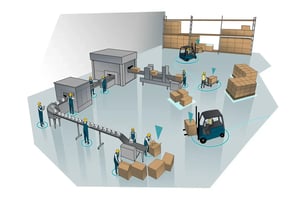
RTLS solutions for Logistics
IoT technologies and RTLS systems for visibility, efficiency, and process safety in the logistics sector.
RTLS solutions for Manufacturing
RTLS systems to identify and track vehicles, people, and products in industrial environments, improving efficiency and safety.
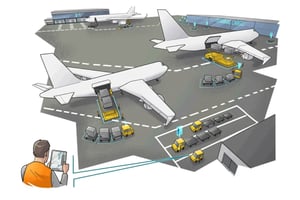
RTLS solutions for Transportation
RTLS solutions for monitoring vehicles and goods in road transport, shipyards, airports, and air transport.
Ubiquicom Ecosystem

Intensive logistics solutions with Artificial Intelligence applied to RTLS

The UBIQUICOM ecosystem also offers the power of artificial intelligence applied to WMS and warehouse logistics to optimize workflows by reducing storage and picking/putting times.

The SYNCHRO system uses high-precision locating technologies combined with AI. Activities are constantly adapted to maximize productivity, increase efficiency, and reduce costs.
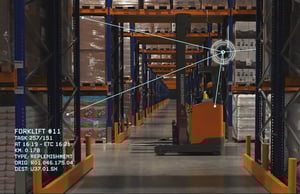
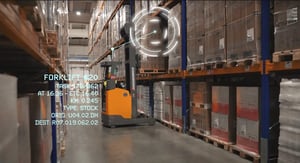
Artificial Intelligence applied to RTLS and WMS
Optimization of forklift missions in intensive logistics
Optimize workflows by reducing pick-up/deposit times with artificial intelligence
SYNCHRO is a tailor-made solution for the high-volume logistics sector. It reduces forklift mission times, generating an average saving of up to 20% in total handling time.
Ubiquicom's range of proprietary solutions

A complete modular system for efficiency

PROXIMITY
Safety & anti-collision
Collision avoidance and safety management systems, designed to prevent hazardous situations in which material handling vehicles operate.
TRACKVISION
Telemetry & fleet management
Platform that enables integrated and optimized management of the material handling fleet, compatible with any industrial vehicle, regardless of make and model.
LOCATOR
Real-Time Locating Systems
Platform for real-time localization, tracking of people, vehicles and assets, telemetry and real-time management of complex location-based events.

Benefits of RTLS solutions

What benefits do RTLS systems offer for the Logistics, Manufacturing, Transportation, and Healthcare sectors?

icon-economic-growth Operational efficiency

Up to 20–30% reduction in asset search time, 15–25% improvement in space utilization, and 10–20% increase in throughput.

 
icon-report Visibility and analytics

Real-time dashboards, traffic and congestion heatmaps, predictive analytics for maintenance.

 
icon-trend Scalability

Start with a pilot area and expand progressively across multiple sites.

 
icon-euro Cost savings

Less lost inventory, optimized labor allocation, lower capital expenditure.

 

Identifying the position of assets (people, vehicles, and goods) enables more efficient operations.

UBIQUICOM vertical solutions provide 15-25% efficiency savings through a set of key factors, including:

  • Visibility: identify available assets to decrease research time, enhance process transparency, and maximize resource use
  • Compliance: reduce mistakes in product identification, transportation, and routing
  • Automation: automate the collection, release, consumption of resources, and inventory management
  • ProcessOptimization: improve resource allocation and orchestration leveraging Artificial Intelligence
Contact us

Ask us how we can help you improve the efficiency of your processes with RTLS!

Request a RTLS requirements analysis to identify the best solution for your situation. Book a demo to see real-time location systems in action.
Blog articles

Learn more about RTLS from our blog

Read our articles on RTLS systems and find out how we can help your business.

FAQ

Insights and FAQs on RTLS systems

How to choose the right RTLS system for your business?

Criteria to evaluate when selecting a solution:

  • Accuracy requirements: centimeter-level (UWB) or meter-level (BLE/Wi-Fi).
  • Environments: indoor, outdoor, or both.
  • Number of assets to track.
  • Existing infrastructure: Wi-Fi, WMS, ERP.
  • Scalability and budget.
How does artificial intelligence transform logistics, manufacturing, transportation, and healthcare?
  • AI and Machine Learning: analyze RTLS data to optimize mission assignment, vehicle routing, and workforce scheduling. Identify anomalous patterns and suggest process improvements.
  • Digital Twin: a virtual replica of the warehouse fed by real-time RTLS data. Enables simulation of layout changes, peak season scenario testing, and operator training in a safe environment.
  • Predictive analytics: using historical and real-time data, anticipate equipment failures, operational congestion, and inventory needs before they occur.

Read our blog article "What is the Digital Twin in Logistics and 3PL??"

What is an RTLS?

RTLS (Real-Time Locating System) are systems designed to monitor and locate objects, stationary or moving, and people inside or outside a specific space in real-time.

It provides continuous visibility into everything that moves within warehouses, production areas, and yards. It supports data-driven decisions thanks to real-time analytics and predictive models. It is used in logistics, manufacturing, transportation, healthcare, and a growing number of sectors.

What is an RTLS system composed of and how does it work?

  • Tags/transponders: devices attached to the assets, vehicles, or people to be tracked.

  • Anchor/reader: fixed infrastructure that receives signals from the tags.

  • Location engine and application layer: software that calculates the location and makes it usable through dashboards and integrations.

  • Tag/transponder: dispositivi applicati agli asset, veicoli o persone da tracciare.

  • Anchor/reader: infrastruttura fissa che riceve i segnali dai tag.

  • Location engine e application layer: software che calcola la posizione e la rende fruibile tramite dashboard e integrazioni.

The location can be obtained with two different approaches:

  • Direct approach: when the number of objects to be tracked is medium or low and continuous object tracking is required, or the resource flow is complex.
  • Indirect approach: when the number of objects to be tracked is high, and they movement is being done by specific vehicles, tracking is carried out indirectly through the location of the vehicles used for the movement itself.
icon-chrono
REAL-TIME
RTLS tags and devices are read automatically and continuously in an active mode.
icon-area-locating
LOCATING
No need for a controlled process to determine the asset’s location.
icon-aree-configurabili
INDOOR + OUTDOOR
Full perimeter Indoor and Outdoor location and continuous Real–Time Tracking.

What technologies can be used for real-time locating?

RTLS use different technologies and methods to obtain localization, which is more or less precise and instantaneous. The technologies used in RTLS systems include:

  1. RFID (Radio-Frequency Identification): this technology uses tags emitting radio signals that can be detected and read by RFID readers placed in the environment; the location of objects or people is determined based on the reception of the RFID signal.
  2. UWB (Ultra-Wideband): this technology uses ultra-wideband radio signals to precisely measure the distance between nodes; using multilateration (also often referred to as “triangulation”), it is possible to calculate the position in real time.
  3. Bluetooth Low Energy (BLE): using devices compatible with Bluetooth Low Energy technology, it is possible to monitor location in real time within a specific area.
  4. WiFi: some RTLS systems leverage existing WiFi networks to determine the location of objects or people based on WiFi signals received from different access points. WiFi is also used to communicate data.
  5. GPS: a satellite technology widely used for outdoor location tracking, providing the position and movements of objects or people with an accuracy of a few meters. A widely used variant in the field of Real-Time Locating Systems (RTLS) for centimeter-level accuracy in localization is Real-Time Kinematic (RTK) GPS.
  6. Mesh networks: in a RTLS based on Mesh networks, network nodes can be used as reference points for calculating the position of a device. In practice, the device uses the signal strength received from the network nodes to determine its own position. Mesh networks are very useful in location systems because they allow for wider and more uniform coverage than simple WiFi networks. Another advantage of Mesh networks is their scalability, which can be expanded as needed by adding more nodes. An additional advantage is that a single infrastructure may be used for both communication and location
  7. Inertial sensors: sensors such as accelerometers, gyroscopes and magnetometers are often used to measure the movement and orientation of objects or people.
AI Insight:

Key values ​​of RTLS systems

Identifying the position of assets (people, vehicles, and goods) enables more efficient operations, providing up to 15-25% efficiency savings.

Quick Answer:

How to improve efficiency by 15-25% with RTLS systems

UBIQUICOM offers a one-stop-shop platform aimed at large enterprises to support a wide range of use cases. The systems provide process visibility, automation, and orchestration, leveraging Artificial Intelligence and relying on multiple real-time locating technologies. UBIQUICOM provides vertical solutions that address industry-specific pain points by combining location information and industry logic.

The company’s competitive advantages lie in:

  • A deep, state-of-the-art know-how of RTLSReal-Time Locating Systems and enabling technologies;
  • A set of unique, patented solutions;
  • Reliability demonstrated through severalthousand customer installations.
Expert Recap:

4 key factors of RTLS

  • Visibility: identify available assets to decrease research time, enhance process transparency, and maximize resource use
  • Compliance: reduce mistakes in product identification, transportation, and routing
  • Automation: automate the collection, release, consumption of resources, and inventory management
  • ProcessOptimization: improve resource allocation and orchestration leveraging Artificial Intelligence